


SHOW NOTES
A billion people worldwide are living with obesity. The medications finally work. And fewer than one in ten of the people who could benefit will get them by 2030.
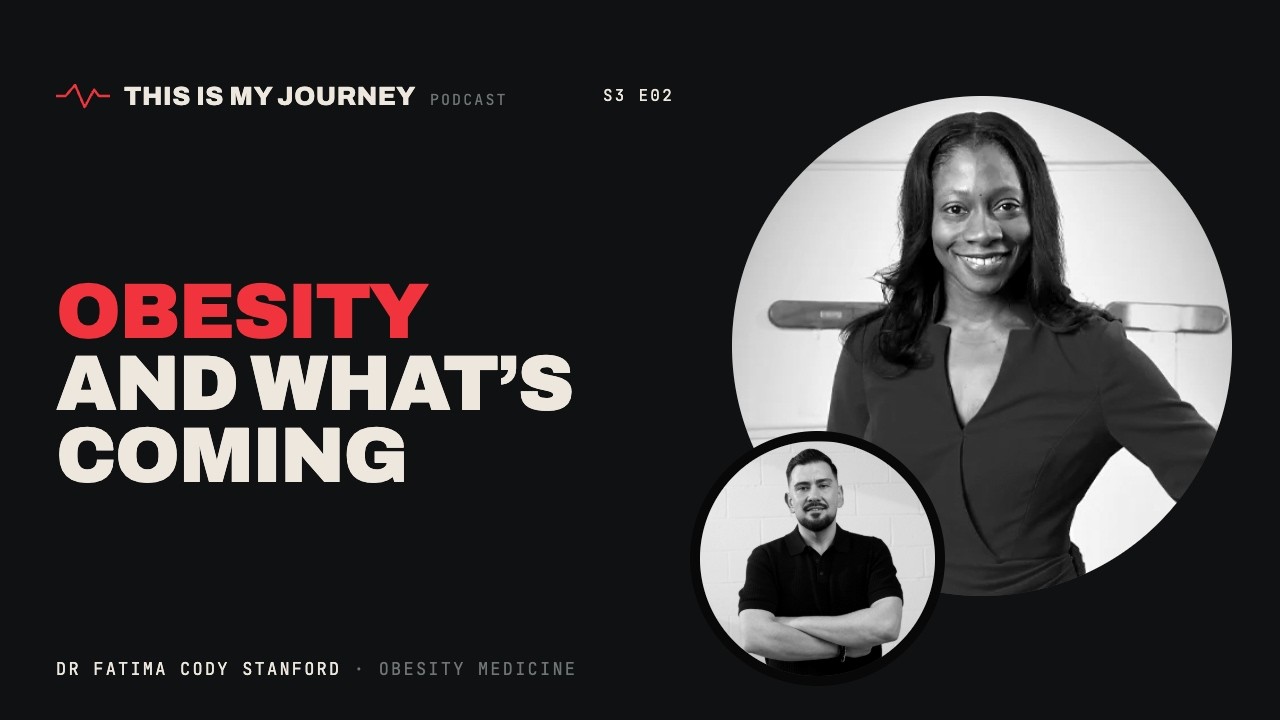
In this episode I'm joined by Dr Fatima Cody Stanford, obesity medicine physician-scientist at Massachusetts General Hospital and Associate Professor at Harvard Medical School. One of the first fellowship-trained obesity medicine physicians in the world, she has published over 300 peer-reviewed papers, sat on the 2025 US Dietary Guidelines Advisory Committee, and contributed to the Lancet Commission that redefined clinical obesity. Many of you will know her from Oprah's weight-loss special.
We talk about what's coming next: the triple agonist retatrutide, which produced average weight loss of over 28% in trial results presented in June, with two thirds of people on the top dose finishing no longer clinically obese. We also cover why almost nobody will be able to get it, the black market already selling it, why people with type 2 diabetes lose less weight on these drugs, and the body dysmorphia that doesn't disappear when the weight does.
SOURCES REFERENCED IN THIS EPISODE
- World Health Organization, first global guideline on the use of GLP-1 medicines in treating obesity, published 1 December 2025.
- TRIUMPH-1 figures from Eli Lilly's topline release, 21 May 2026, and Dr Ania Jastreboff's presentation at the 86th ADA Scientific Sessions, 6 June 2026. Presented at conference and not yet peer-reviewed.
- TRANSCEND-T2D-1, The Lancet, June 2026.
Lancet Commission on the definition and diagnosis of clinical obesity, January 2025.
ABOUT THE GUEST
Dr Fatima Cody Stanford
Dr Fatima Cody Stanford is an obesity medicine physician-scientist at Massachusetts General Hospital and Associate Professor at Harvard Medical School. One of the first fellowship-trained obesity medicine physicians in the world, she has published over 300 peer-reviewed papers, sat on the 2025 US Dietary Guidelines Advisory Committee and contributed to the Lancet Commission that redefined clinical obesity.
MORE EPISODES LIKE THIS
Hair Loss on Mounjaro: What Actually Helps
S3 E3 · Nyrah Saleem · 30 min
Mounjaro and Your Gut: What GLP-1s Really Do
S3 E1 · Dr Karan Rajan · 24 min
HRT, Mounjaro and the Heart in Midlife
S3 E4 · Dr Komal Patil-Sisodia · 46 min
FULL TRANSCRIPT
Today in This Is My Journey, we're talking to someone I have wanted on this show since the day I started it. In December, 2025, the World Health Organization published its first ever global guidelines on GLP-1 medications. More than a billion people worldwide are living with obesity. about one in eight of us, and obesity was linked to 3.7 million deaths in 2024. And the World Health Organization's own projection is that these medicines will reach fewer than one in 10 of the people who could benefit by 2030. Their warning was blunt.
Without deliberate policy, access to these therapies could make health inequality worse, not better. So fewer than one in 10. And meanwhile, the medicine keeps getting more powerful. There's a new drug in trials right now, three hormones at once, retitutide, with results that make everything we have got today look modest. So this episode is about the whole picture, what obesity actually is, why so many of us were told for decades that it was our fault,
what the bias in a doctor's room does to a person, what you should genuinely be eating while you're on one of these medications, and yes, what's coming and whether any of us will be allowed it. So my guest has spent her entire career on exactly that ground, and I couldn't be more excited to dive into it today. So let's roll the intro and get into it. When I started, I was on my own. Two years ago, I began GLP-1 medications for chronic obesity, with no real idea of what was coming. Not the good parts, not the hard parts, and definitely not the parts nobody warns you about.
So I went looking for answers, and what I found, was just noise, opinions, judgment, people selling something and everyone had a take and nobody had the truth. 126lbs down, I'm still on this road, still learning, still working out what maintenance actually means because losing the weight, it turns out, was only half the story for me. I'm Marc and this is, this is my journey. Every week I sit down with the people I couldn't reach back then. Leading doctors, obesity specialists, psychologists,
Dietitians, fitness experts, surgeons, and the people who actually understand what this medication does to your body and your mind and who'll tell you straight. And alongside them, working professionals and people walking the exact same road as you. Because their answers, they matter just as much. Just honest conversations about what this really takes, the science, the setbacks, and the stuff you won't hear anywhere else. If you're on GLP-1s or you're thinking about starting them or you're just trying to make sense of it all, this podcast is for you because nobody should have to do this alone, not anymore. Welcome back, everyone.
Today, I'm joined by an obesity medicine physician scientist at Massachusetts General Hospital and associate professor of medicine and pediatrics at Harvard Medical School. Dr. Fatima Cody-Stanford was one professor. of the first fellowship-trained obesity medicine physicians in the world. She's published over 275 peer-reviewed papers. She's among the most highly cited researchers in her field. She served on the 2025 US Dietary Guidelines Advisory Committee,
And she contributed to the Lancet Commission that redefined clinical obesity in January last year. She's also an equity director of the endocrine division at Mass General. And many of you will know her from Oprah's weight loss special and countless other TV and media appearances. Dr. Stanford, I am so excited. Thank you so much for joining me today. Marc, it is my absolute pleasure to be here.
I'm looking forward to a great time together. Yes, no, I'm absolutely ecstatic to try and get some of the answers that I have to questions that have been plaguing my inboxes and what people have been asking. So I'm so glad to be able to put them to you. So I suppose just to get started for anyone who maybe hasn't come across your work. which they probably have. They just maybe haven't known it.
Could you maybe start by telling us maybe something about yourself we won't know and what made you go into obesity medicine at a time when there were barely any fellowship trained physicians in it at all? Yeah, so let's see. Tell you something that you wouldn't know by like searching for me. I'm trained in dance. So I started training in dance at the age of three. I'm trained in ballet, jazz, West African, hip hop and point.
I minored in dance in college and used to choreograph for Emory University's dance company. I used to teach for the Georgia Ballet here in the United States and used to direct a dance program at one of our MCAs before I went to medical school. So that's something that you wouldn't immediately know. by looking at me or trying to Google me or something of this sort. But let's talk about me and what drew me to this work. So I was born and raised in Atlanta, Georgia, here in the US.
And what I typically saw is individuals that put forth a lot of lifestyle, I guess, efforts, let's say lifestyle efforts. meaning modifying their diet, looking at physical activity. And despite all that they tried, they would still defend a higher set point for weight, meaning carrying excess adipose tissue, which is fat mass, despite really everything they're doing. And this was frustrating to me. But if we go back to the late 90s and early 2000s when I started, and one correction, I have over 300 peer-reviewed articles now. I...
I could see that, you know, I was really invested in lifestyle. This was the, if people remember, the Billy Blanks Taibo era, all of those things that, you know, I used to do in my dorm room before heading out to my classes. And as someone who has defended a lower set point for weight, those things worked for me in helping me to maintain my weight. And You know, at the time I was like, well, you know, can't people just work harder? Can't they just do something better?
And so very much in the lifestyle camp of like, OK, if only people tried harder, did harder, worked harder than they could be, you know, where I am. And I recognize as I saw certain family members and friends and, you know, kind of extended colleagues doing similar things. but yielding very different results than I was yielding in my time with dance or track and field or whatever it might have been. And, you know, that was, you know, somewhat stimulating to me to say, you know, there needs to, there's more to this equation. And so, you know, if I think about some of the advice I gave really late 90s, early 2000s, and move that over to 2026, I can see significant differences in how I think about it because I didn't understand the disease. And I think my previous thinking really reflects the world's thought process.
Just try harder, do harder, be better. And it's flawed. But I saw so many people struggling and eventually struggling. I came into a space where I can actually yield, you know, some results and actually help them be their best self. Yeah, no, I think, you know, your whole work is outstanding for what you've done. And there was a phrase that you coined that I haven't really been able to stop thinking about once I read it.
And. It was the word street corner medicine. So maybe explain that for anyone listening, you know, what you meant by that, you know, where it came from. Absolutely. So actually, there's a well-known reporter, Sanjay Gupta, on his show actually coined this term street corner medicine. But I used it, obviously, before the show, which is why I was able to say it when I spoke to him.
And let's talk about what street corner medicine is, or this kind of colloquialism that I've termed here. This is the idea that if you were just walking down the street and you saw a person, particularly someone that has excess weight, so has obesity, you look at them and you assume you know everything about them. You assume you know how they eat. You assume you know how they exercise. You assume you know all of the things about them. And specifically when I add the medicine part, as a doctor...
I could, you know, maybe make an assumption, oh, they must have high blood pressure, they must have high cholesterol, they must have this, you know, and I can keep going on and on. But the problem with this, and this is how we judge persons that have obesity, is that we're judging the book by its cover. We're sitting on the street corner watching people go by, making assumptions about their value, their worth, and their health without ever doing a deep dive. It's really not very hard for me to do an assessment on a patient with obesity, but I can't do it by just looking at them as if I'm standing on the street corner and making an assessment. So that's what we do. We stand on the street corner.
We see people in our various, you know, walks of life. Maybe we're at the airport. Maybe we're going to the grocery store, wherever it is. And we see someone that carries excess weight and we automatically assume we know what must be going on with them. that's problematic. It leads itself to bias and stigma.
And it continues to project this narrative that obesity is a disease about willpower, not a disease at all. And so this idea of street corner medicine, which unfortunately I see quite a few of my colleagues yielding to, is really highly pervasive. And I just believe we need to stop. Let's stop standing on the street corner and assuming we know everything about the person that's walking by just because they carry a excess weight. I love everything that you stand for around this and this is why I've you know really wanted to have this conversation because I think you just get somebody that I think has has lived this and and I think you're such an advocate for and I suppose I can say it you know an advocate for me you know in terms of you know being on you know somebody that you
has been that bigger person and I still feel like that bigger person inside, but that's about me and more about you. So you were the one of the first fellowship trained obesity medicine physicians in the world at a time when the field barely existed. Can you explain what that is? And was there a particular patient early on who changed your practice? Yes. So the fellowship, I'll just explain what that is, and then I'll go back to talk about a patient that highly influenced me early in my career.
So here in the United States, you can do fellowship training in the field of obesity. Here at Mass General, when I did my fellowship, we required to do a minimum of two years. I did three years of fellowship training just focused on caring for patients with obesity. Now, I happen to be an internist, which means I take care of adults and a pediatrician, which means I take care of children. So I really take care of the full spectrum. And I always like to say my patients go from twinkle to wrinkle, you know, as young as age two, as old as 90 plus.
And these are my patients. They reflect families. They reflect generations of individuals that have this disease process, really talking about that high degree of heritability of this. So that's the fellowship training, which I completed after doing my residencies in internal medicine and pediatrics. I came and did three years of fellowship here at Mass General at Harvard and then stayed on the faculty. And so that's really kind of the entry into the field and really pretty much understanding the science of the field.
Going back to my early career, There's one particular patient that really stands out. This woman, it's interesting because now I'm past her age, but this time, that's humbling. She was in her mid-40s, which means that obviously I must be older than that. So she was in her mid-40s and she was a patient of mine in my internal medicine clinic when I was in residency. So this is a woman who had severe obesity.
And every single time she would come to visit, she was never late, always there, always present, you know, had severe obesity. And I would give her a lot of lifestyle, you know, I guess tools and tips, I guess you could say. OK, so we should be doing this in terms of eating. We should be doing this in terms of exercising. So after the first three years, my training in internal medicine pediatrics, four years in training. So let's let's go about the third year of my training.
I happened to run into this patient. at the grocery store as she's about to check out at the grocery line. I guess, you know, like she has her buggy. It's completely full. I happen to run into the store. I see her.
She says, and I'm like, oh, hi. And so we're talking, but I'm really trying to eye her grocery cart to see what's inside, right? Without, you know, being inconspicuous as much as I can, failing miserably at that. Because she says to me, see, Dr. Stanford, I've done everything you told me to do. And what she was remarking about was that if you looked at this very full grocery cart, she had everything we had ever discussed over those first three years.
Yet she was still defending this high set point for weight. She still had severe obesity, but there was not one item in her cart that deviated from what our conversation was over all those three years that I've been working with her. Now, I'm going to fast forward to about two to three weeks later, and this is a reference to the same patient. I happen to be working a shift in the emergency department. So I'm in the emergency department. You know, the emergency department, things are going fast.
Everything is going fast. And I get to this woman and she's like, you know, I think you're I think you're my cousin's doctor. And I was like, what? I was just I'm just moving fast. I'm like, OK. OK. And then she's like, yeah, you are.
I think you are. She talks about you all the time. She's always trying to get me to go exercise. She's trying to do. So here's a second clue, right? We already have seen her eating patterns or what she's buying specifically.
Check done. Perfect. Here you have someone totally has no idea that I'm going to be one of the doctors in the emergency room, happened to be the cousin of the person I'm talking to. now telling me she's always trying to get me to go exercise with her. So we have the two primary lifestyle tools that people can utilize, right, to drive weight status. She's been doing it.
She has a third party here that happens to be in the emergency department while I'm running around doing things. And it was at that point that I realized that I had failed her because I had been constantly giving her these tools. She had been doing them. They were ineffective tools. So the tools failed her, not she failed the tools themselves.
Okay, yeah. And I didn't have anything else to give her. It was like, okay, I'm sorry. And it was, you know, if I go back to that person, you know, 15, almost 20 years ago, I realized that if I knew what I know now, then her life would be very different. But I just knew lifestyle. I didn't know metabolic and bariatric surgery, really.
I didn't know pharmacotherapy. Of course, the pharmacotherapy tools were very different back then, but they were still available for us to use. And so I feel like I failed her. And that's very heavy to me, no pun intended. As someone who's very empathetic, I realized that my lack of knowledge influenced her quality and quantity of life. And so I think that was a really influential story for me.
It's very touching just how you have taken that. I suppose with a lot of these experiences, you know, they channel a lot of how we go forward and influence all that. So thank you so much for sharing that with us, because obviously it's a very personal story too, and you can almost, you can sense just how that has made you feel. Going into the big one now. So. Because it is the thing I myself and everyone listening carry the most shame about.
So you've been very clear for years that obesity is driven by genetics, development, stress and environment and not willpower. But, you know, you've already mentioned that already. Can you maybe explain what's actually happening in the body and what set point theory means for somebody who has dieted their whole life and always ended up back where they started? Okay, so let's talk about obesity as a disease, right? So obesity as a brain disease, I've said this on 60 Minutes, a lot of people got upset with me, but it is what it is. If we look in a particular part of the brain called the hypothalamus, there helps us understand some of the signaling that happens that helps, you know, one person be lean, one person have obesity, and let's talk about that.
So there's Two primary pathways by which the brain will travel to regulate weight. There's an anorexigenic. So we hear anorexia, anorexigenic, that you can imagine defends lean set point. And then there's an orexigenic, which is the opposite of anorexigenic. Now, without making it too complex, I'm going to use a little few terms.
Don't worry, I'll bring it back to you. If we go down the anorexogenic pathway, which is the POMC or the pro-opio-melanocortin pathway, we stimulate the production of something called BDNF, which stands for brain-derived neurotropic factor. And we have high levels of BDNF. We defend a lean set point for weight because we're stimulating the production of BDNF. Now, when we go down the orexigenic, remember orexigenic is the opposite of anorexigenic, we actually are blocking or inhibiting that pathway. And unfortunately, when we go down that agouti-related peptide pathway, we have low levels of BDNF.
Again, that's brain-derived neurotropic factor. And we defend excess fat mass. Now, a lot of people didn't realize that it's not just how I think. I can't tell my brain to signal down the anorexic pathway like that. I would just stop working right now because I would solve obesity. But inherently, there's different things that are causing us to either go down the anorexogenic pathway or the orexogenic pathway, things that endogenously exist.
And I know we haven't started talking about GLP-1s, but I think everyone needs to realize that as humans, All of us have GLP-1 inside of us, which is glucagon-like peptide 1, okay? All of us have GIP, which is glucose-dependent insulin-tropic polypeptide inside of us. Those of us that happen to have more at baseline, well, guess what? Go down that anorexigenic pathway. Eat less, store less, and defend a lean set point for weight, okay?
For those of us who do not have as much on board, you can imagine we probably go down the opposite pathway, the orexogenic, and then this is problematic. So I think it's important for us to recognize this, particularly as our brain is in an environment that's considered obesogenic. So we have genetics, which plays a role in how we might inherit obesity, right, from our parents, grandparents, etc. We have development, how we develop, how we're conceived, all of these things having an influence. We have our behaviors influencing things. If we have high levels of stress, we're going to store more adipose tissue.
That is what biologically and from a perspective of how we've gotten here as humans, why we defend more weight over time, because that was protective in times of stress. You know, a famine was probably coming. So what does the body do? It stores that mass to prepare for the famine that often just doesn't come. So all of these things interact together to drive us up over time, whether you're in the UK, whether you're in Scotland, whether you're in the US, whether you're in. Sub-Saharan Africa, it doesn't matter.
Those things play a role. And so when we think about this obesogenic environment acting with our biology, it shifts us gradually towards carrying excess weight. Now let's talk about the set point theory, because I think this is really important for people to understand. And when we look at set point, it's this idea that my body will kind of recalibrate to a certain weight no matter what I do. So let's throw out, I'll throw out, I guess, in pounds and maybe I'll do kilos for, you know, because the U.S. is the whole one that does pounds. So let's say someone were to weigh 250 pounds, let's say, or, you know, 150 kilos, some larger number, and they attempt to lose weight.
So let's say they get really aggressive with the diet modifications, restrict calories, we're doing exercise and they lose, you know, a certain amount of weight. And then over time, you know, they start to drift back up. It's because the brain remembers where that weight was and it has compensatory mechanisms to drive it back to where it was prior to the intervention. Ghrelin, which is a key hunger hormone, probably stimulates quite a bit. And you're like, well, gosh, well, I don't know.
I'm doing all the things I'm doing, working so hard. But the brain always remember, think of it as like a thermometer. And if you set it at a certain temperature to bring the cool air on or the warm air on, it's going to get whatever it needs. And then once it gets to a certain amount, it's going to just stay at that number. Okay. And the brain is powerful.
It's going to do all of these compensatory mechanisms with hormones like ghrelin, like cholecystokinin, peptide YY, GLP, GIP, etc. It's going to work against you to bring you back to the weight you were prior to whatever intervention. And unfortunately, many times even take you above because the brain is angry that you, how dare you try to lose weight? No, that's not fair. This is where I want to be. And so what we can see often over our lifetimes as we enter into, for example, middle adulthood where I am now or go beyond that, is that weight ticks up because we've done this weight cycling.
We've lost weight. We've gained weight. We lost weight. We gained weight. And then we just keep going up this ladder and we're frustrated because we've put in so much time and so much energy. But the brain always wins.
Well, honestly, I don't think I've ever heard what you've just explained there so amazingly put. in terms of actually being able to understand that science and literally you're talking and I'm just, my brain is just ticking away because I'm understanding what you're saying, because I think that that's the difference. I think with some of the science and this terminology, it's really hard for the normal person to actually understand this and what's happening in their body, you know, absolutely incredible. Again, this was another one that really wanted to ask and it obviously does relate to GLP-1 slightly but you know you contributed to the Lancet commission that redefined clinical obesity and moved us beyond BMI so in practical terms what does that change for an ordinary person sitting in a doctor's waiting room? Well, right now, I would say we're still early in terms of shifting the whole medical community in terms of rethinking.
But I do want to talk about the problems with BMI. And so for those who are listening, BMI is body mass index. It is a set of numbers that are put in place to determine whether you have normal weight status versus if you have overweight or have obesity. normal. And notice I'm putting that in quotes. If you're between 25 and 29.9, you are considered overweight.
And then when we get to a BMI greater than or equal to 30, you're considered to have obesity. And then there's three classes of obesity. If we're looking at adults, I'm There's class one, class two, class three obesity. Class one would be mild obesity, a BMI of 30 to 34.9. Moderate obesity would be a BMI of 35 to 39.9.
And then those with severe obesity would have a BMI greater than or equal to 40. Okay, so just wanted to throw that out there. But let's look at the origin stories of BMI. And I'm about to shake your world up. So I'm going to take you to the 1800s. And I'm like, where is she going there?
Because that's where the story starts. There was a Belgium statistician by the name of Adolf Kutelet, Kutelet, depends on how you pronounce it, tomato, tomato, who decided he wanted to look at what was considered normal weight status for Belgium white male soldiers at the time. And he came up with this kind of Kutelet index. It was then adopted by Adolf Hitler. You might have heard of him, and I'll let you decide what you think about him and determine what was considered normal. Okay.
And then if we move over to the 1930s, particularly here in the United States, the Metropolitan Life Insurance Company said, well, you know what? We need to determine what your risk of dying is based upon your weight status. Hence the term morbid as it relates to obesity. What's your risk of dying? So we have actuarial companies now determining morbid. And now I'm going to shift it over to a really great decade to be born in the 1970s, where all were keys here in the United States.
So, you know, let's just, this is really simple. Let's just look at height and weight and determine weight status. Now, what you heard in me telling that story was there were no doctors involved. There was no medicine involved. These were all just approximations based upon what either Adolf Kutley, Adolf Hitler, their names are familiar.
I'm just realizing that now. The Metropolitan Life Insurance Company and then Keyes came up with to determine what's considered healthy or not. Okay, some flaws there. Have we looked? I feel like we're practicing street corner medicine here. Are we doing anything to really look at the health of the individual?
And so if we go to the Lancet Commission and, you know, and I think all of my commissioners, particularly the person who led this, Dr. Francesco Rubino, out of the UK, we said, okay, well, this is flawed. Like, have we looked at the health status of anyone? Have we really done a dive to discern, you know, what someone's weight status means? And so the commission decided to look beyond just BMI. It wanted to look at health status.
Like, do you have other disease processes that are affected or caused by obesity? Let's look at waist to hip ratio. Let's look at waist circumference. Let's look at things that actually help us define the severity of one's disease and, you know, really make some determinations. And so the Lancet Commission met for several years to kind of come up with this idea of preclinical obesity and clinical obesity based upon weight status and comorbid conditions, impaired physical functioning, things of this sort. The only thing we kept in place in terms of the BMI was that if someone has that BMI greater than or equal to 40, which we remember is severe obesity, we do agree that that should be kept in place.
Just because usually once we get into that domain, we usually do have, you know, major signs and symptoms associated with the disease. But prior to that, let's do a deep dive. Let's not do the street corner medicine situation. Let's determine what the person has. You might have an athlete who actually has a BMI that places them with mild obesity, but they're much healthier than someone this much leaner. And so this is, you know, we wanted to get into exploring this.
And so this is where the Lancet Commission decided to put its efforts and time. Now, as a person goes into the clinic, you asked me, well, how this influenced? I think that we're still early in it, you know, moving beyond BMI because it's been so standard. It's, you know, easy to use and people like easy, right? But easy doesn't mean right. And I think that's where we were really concerned and why we spent our time, you know, drafting the Lancet Commission.
Honestly, it's one of them things I hear all the time to people who are very, very healthy. If we're talking about how they physically look and they're classed as obese on that and it's just ridiculous. Obviously, the work that you're doing there is fantastic on that because I think it is, it's a, it's a needed change for sure. And also, I think it helps towards reducing that stigma, I think as well, because as soon as you hit that number, you know, on that scale, it's like, okay, that person's class does that. And then that, you know, I think that sits with you, you know, regardless if you're a healthier person or not. So getting into that GLP-1 space now.
So you co-authored the joint advisory on nutritional priorities for people on GLP-1 therapy. So when someone's appetite has completely gone and they're eating just a fraction of, you know, what they used to eat, what should actually be on that plate? And what are you most worried that they are missing? So this is really important. And I appreciate this question. When I'm talking to patients, and I'm thinking about my patients right now, I just saw patients all day yesterday.
So I'm laughing with our interactions because many of my patients have been with me for quite some time. But, you know, we want protein, whole grains, fruits, beans, legumes, lentils, etc. This is what we want. But keep in mind, like you said, that is going to be a reduced portion size. So your portion size may actually look like this little circle that I'm doing, right? When you're used to it looking more like this.
And often that really, you know, confuses patients because they're so, they've been conditioned to having a plate more like this. And then all of a sudden they're eating this or even like this, right? Like even smaller meals. And that can be bewildering. So notice I said, you know, protein, whole grains, fruits, you know, vegetables, beans, legumes, lentils, et cetera. Those are, listen to that.
That's very robust. We get some fiber, we get protein, right? which are really, really important. Why are these important? Let's talk about protein first. And protein doesn't have to come from animal sources.
You maybe have to practice veganism or some type of form of vegetarianism or whatever it might be. These can come from plant-based sources. This is important to know. But protein is a really important building block of muscle, okay? And we want to have that on board, but not so excessively that we missed out on like fiber content, right? So we want that fiber.
content. There are two reasons. When we're losing weight from GLP-1s, we're losing weight and the body can't differentiate between whether it's losing fat or fat-free mass, i.e. muscle, okay? And so we're doing things within our own domain, i.e. promoting protein to help build as much as we can.
With regards to fluids or hydration, really important because medications that are GLP-1 slow movement through the GI tract. So you can see my hand moving very, very, very slowly, very, very slowly. That's actually too fast, but I have to give you something. So what happens is we need to increase that fluid content also, right? Because if we know that the mechanism of action is to slow movement through the GI tract, which promotes satiety appropriately. sense of fullness that we're going to need fluids to kind of come down so that we're not so backed up.
I talked to patients yesterday and one patient was like, yeah, I go to the bathroom. I eat half stools once to two times a week. I was like, what? She's like, yeah. And I was like, no, no, that's not acceptable behavior. So we're going to have to modify, you know, sometimes I have to add some additional medications into the plate, but also modify what she's drinking.
She's like, yeah, just drink one cup of coffee a day. I was like, what? What? One cup of coffee a day, that does not go with our guidelines. We, you know, we're looking at much more robust volumes of fluids. And it's really important because what happens is when we're on these medication, your desire to eat goes down, but your desire to drink also goes down.
So I need both of these to be robust in light of the things that we just talked about. Just from my own experience, definitely hydrating more really, really helped that scenario. For me, it was easily two to three liters a day of water that I was drinking and still am and making a mission to get that in every day because it is so important. I suppose your, you know, qualitative work is titled One Size Does Not Fit All. So what did patients tell you in those interviews that genuinely surprised you? And what do you wish every clinician could hear?
So I think we try to put people into a cookie cutter, right? This is where the BMI flaws like, oh, you've got to get to this weight. So let's talk about that. So let's say a person came in and, you know, I'll use kilos. Let's say they carry their 50 kilos overweight, okay, based upon BMI. And I say, oh, well.
You know, I'm the doctor, so I'm supposed to be all knowing, right? I know all things, but I'm just human, just like everyone else. But just pretend, right? This is what happens, you know, kind of this paternalistic approach. I know everything. And I say, you know, Marc, you must lose 50 kilograms.
And you're like, okay. So let's say we go on a journey and you lose 40 kilos, which is really great. But you're always going to feel like you failed. Because what number did I give you on day one? I gave you 50. Okay.
And so even though you lost 40 or even 45, you didn't lose 50. And so your sense of self-worth, despite the fact that you've accomplished what you've accomplished by whatever means, surgery, medication, whatever it might be, you still didn't achieve the goal. You technically failed. And so when we look at this idea of one size fits all, if I give someone a target weight, which I never do, and I'm strategic in not doing that because I want you, the patient, to get to the happiest, healthiest weight for you. I don't know what that is when we start off. I look at the full health of the individual.
So when you came in to me, yes, you know, let's say we had X amount of excess. But also, what was your health status? Did you have evidence of heart disease? Did you have evidence of diabetes? You have evidence of osteoarthritis, all these things. Did these things improve once you got to the happiest, healthiest week for you?
And so for me to apply a blanket number or percentage or whatever to just everyone that walks through my door would be flawed. I have to tailor it to fit the person in front of me at that time to make sure that they are getting to, again, the happiest, healthiest weight for them based upon me doing a deep dive and not just judging the book by its cover. And I really think that's where the one size fits all does not fit all approach comes from. Yeah, there's so much there resonating with me just when you were speaking that I think at the start of my journey with weight loss, it's really hard to put that number on what do you want to get down to. And for me, that's why it was never, I think, about any of that. For me, it was always, I suppose, in my head, I was thinking, I don't know the equivalent, but I'm going to say stones.
So 15 stones. Okay. But the, you know, getting down to that was, I suppose, my little target in the back of my head. And then once I actually reached that, I was like, you know what? I'm still not happy. I'm still, I know where I want to be.
I want to lose a little bit more. Didn't want to put numbers on it. And then as soon as I got to the doctor's office and my stats were good, I was off my blood pressure medication and all the, The stats were coming back good, visceral fat reduction and all that. I was like, you know what? This is me at my healthiest.
And, you know, I potentially could lose a little bit more. But, you know what? I'm happy where I am. And I think that's where I'm going to stick with it because I don't want to go too far down this road, you know? That's really important. I think that people need to, you know, look at those goals that are not associated with weight.
Right. Am I able to run after my kids, my grandkids? Am I able to? But I wasn't before. You know, I had a woman that I was speaking to in the subway station. She's now able to run up the steps, you know, if she needs to catch the train.
And she's like, wow, I've never been able to run up the steps. But now in her 60s, she can run up the steps to, you know, get to the train uninhibited. Right. She can do these things. These are. really great targets that aren't based upon the scale, right?
These are things that change your quality of everyday life. And I think that's really important. Yeah, no, I 100% agree. So I suppose the question I get asked more than any other question is, And I think you're the right person in the world to answer it is, is this medication forever? So are these GLP-1 medications something people can stay on for life?
And if someone does come off, what should they realistically expect? Absolutely. So this is a really good question. I get asked this question a lot. I'm not on these studies. I'm going to talk about the two gentlemen that lead both studies.
But if we look at semaglutide or semaglutide, depending on how you pronounce it, notice it's a tomato thing again. which is under the trade name of Ozempic or Rogovi, or truzepatide, which is a dual agonist, a combination of that GLP-1 glucose-like peptide-1 with a GIP, a glucose-dependent insulinotropic polypeptide. There are two studies that have come out. So Wilding, John Wilding out of the UK, published the withdrawal of medication, i.e. semaglutide.
What happens when you come off semaglutide, which is ozempic wagobi. And he found amongst thousands of people that, you know, about 85% of patients will regain all of their weight. Okay. That's the semaglutide study. So then Dr. Luroni, based out of New York here in the U.S., ran a similar study for chusepapetide. Hey, what happens?
The exact same thing happened. About 85% of patients regained all of their weight when coming off the medicine. Now, this may be disappointing to people, but remember, we're acting on brain biology. So GLP-1s stimulate the anorexigenic pathway of the brain and inhibit the orexigenic pathway of the brain. So this is why people may say, oh, I feel like I reduced... food noise, which is a term that was kind of coined in the general population, not in medicine.
All of these types of things when they come off. Because remember, we have endogenous GLP-1, but if we're giving it to you exogenously, and of course, don't give it in your hand, don't do that. A stomach is my preferred place. But and we pull that back, right? If we take you off of that, we're no longer interfering with those brain pathways. It's not that you did something wrong, remember, because this is not about diet or lifestyle medication.
We're actually giving you something that's going to support how your brain signals. This is the biology of the disease. So if you are like 85% of people, which is a pretty high percentage, you will regain. And so then you might be like, what about those 15% that don't? Like, what do they do? Are they working out more?
Are they eating healthier? No. Their behaviors are the same. Something about them just does not regain in the same way. We don't really understand why that is, what makes those people special, for lack of a better way of saying it. But, you know, so it's not 100% that you'll regain it, but 85 is pretty high.
And it's literally because we're no longer stimulating the pathways that help us to be leaner. Okay. And that's why we are treating it as a chronic disease, something that we treat for the long term. I suppose within the community, I think there's a bit of misunderstanding maybe in terms of whether you can be on these, you know, longer term. So I think it is really good to have that out there. So I suppose, you know, something you raise that almost nobody else does, body dysmorphia after weight loss.
So people reach the goal and they still can't see themselves really accurately. I know I'm one of these people. So what's happening there and what does proper care look like? Yeah, absolutely. You know, I have countless patients that, you know, lose dramatic amounts of weight, 100 kilos, 120. I mean, like these are really large numbers.
And, you know, when they go into, let's say, the store to shop, to buy clothing, they still find themselves gravitating to a size that's like significantly higher. And then they have to recalibrate themselves. And I actually had one patient that said something interesting. To me, that was very interesting that that relates very well to this topic. She said, well, I just don't feel like I deserve to shop for a size six, for example. And I was like, well, why do you feel that way?
She's like, well, just I don't feel like I deserve it. So this idea of value worth, a sense of do I deserve this? And then I asked her, I said, what about the people that have always worn a size six? Do you think they think the same? And she not thought of it from that perspective. That way, yeah.
So when we're looking at this idea of body dysmorphia, which is this idea that I don't know what the body is that I'm in now. How is that received? How am I treated by the external world? All of a sudden, I have a patient. She lost a tremendous amount, maybe 130 kilos over time with me. And she said, people speak to me on the elevator or what you guys call the lift, right?
Like, what? Is that something people do? She never knew that. So it's like it really just changes things. And so then you start to reevaluate who you were before compared to who you are now. Why are you valued differently?
And so this is why I work very closely with our psychologists here at Mass General. We have five PhD level psychologists that work with our patients that help explore how to navigate this space of being in the same body, yet a different body, and how you're received now versus then. And I think this is really important work that often continues for quite some time, well beyond, you know, a patient, you know, having gotten to a substantial loss of weight, you know. I suppose for me, and that's all I can relate to, for me, it's a completely different life than what I have known. Do you know what I mean? And just being able to look in the mirror and, you know, for me, I still see even two years down the line, you know, that person that I was before.
I really appreciate, you know, what you're saying there. And I think it's, it is something that body dysmorphia and all that still needs so much work. And I think it's, it's, it's great that that work is continuing. Yeah. I suppose let's look forward for a moment and you know, hopefully you can talk about this. Okay.
So your AJ MC described you in August as a clinical investigator on their reticulatide trials. Is that right? And for anyone here and triple agonist for the first time, what is it and how is it different from what people are taking today? Yes. So let's talk about retitrutide, which is a triple agonist. So we talked about GLP-1, glucagon-like peptide 1.
We talked about GIP, which is glucose-dependent insulinotropic polypeptide. And now let's throw in another G because G seems to be the letter of the day. It's glucagon. Okay, so this is the triple agonist, right? All three of the G's put together in one medication. The studies that have come out so far and everything that you will hear coming out on Rutter True Tide are called the TRIUMPH studies.
And so currently I am one of the principal investigators for TRIUMPH-6, which means that there were five that came before this and we're in the middle of six studies. In this particular study, it's 125 weeks long, okay? Every single person that came into the study for the first 80 weeks will be one agent. For retitrutide, the dosing is 2, 4, 6, 9, and 12 milligrams of this medication and the dose is 2, 4, 6, 9, and 12 milligrams And then at a certain point, they'll be randomized to either stay on high dose, go to metal dose, or go to placebo. But what makes this drug somewhat different?
We have that glucagon-like component in some of the early studies, i.e. TRiMP1, TRiMP2. We're seeing readouts of about 28.3% total body weight loss. We anticipate a little bit more in this one just because of the length of the study, right? particularly for those that end up staying on high dose for 125 weeks is the longest study. And what you'll hear, you know, Lilly, who's the company that oversees this medicine, say, it's like, okay, well, we're approaching bariatric surgery percentages of weight.
And so how does this differ from semaglutide, ozempic, wagovi? On average, we see about 15% total body weight loss from that agent. Trisepetide, which is the dual agonist, you can see approximately 22%, okay? And now we've moved into the 28% to 29%. And so you can see that jump over. When we're looking at metabolic and bariatric surgery, you know, you're looking at about 30% to 35% total body weight loss is approaching
What I will say as someone who treats a lot of patients who undergo metabolic and bariatric surgery is that when we pair surgery, getting down to like kind of a stable weight with medication, I mean, some of those patients were getting 30, 40, 50, even 60 percent total body weight loss. So that far exceeds anything that we've seen with medicine alone, even the most powerful medicine ever tested, which is amazing. retitrutide. But I think what we'll see that's as different as just the potency of the medication will likely be such that much like the trials, we enrolled higher weight status because it was so powerful, so potent, is so powerful, so potent that it can drop you really to tremendous lows. If you were very lean, a relatively lean at baseline, it wouldn't be necessarily a first line medication because there's the potency of the degree of response. So that's retitrutide.
Is there anything around it yet on like the maintenance side of things? Is it more just for that weight loss and not long term? Oh, no, no. Or is it? No, no. It's definitively like everything else.
So for patients that would go on this, you know, ideally they would stay on it long term, just like semaglutide or truzepatide. Exactly. Okay. And then obviously, you know, we've talked about that, but there is also the darker side, which there's a lot at the minute. Nobody can legally get this drug anywhere in the world right now. And yet there is a thriving gray, black, whatever you want to call it, market, over 100 websites, dozens of clinics around the US, raids here in the UK.
You've written about consumer risk in the compounded GLP-1 boom. And you've said there is zero published data anywhere on the, in the world on medications sold in this way. No data means no protection. So how worried should people be? And are these fakes?
What is being advertised? Because I get messages every single day. What do I think of Reda? And yeah. So, yes, I can answer all of the above. Number one, if it's on the market, it is definitively not retitrutide.
It is not the drug that Lilly has put out because Lilly has not put it out to anyone. If you're in the trials, you are getting the medication. So there are trial participants like my trial participants are obviously getting the actual medicine available. sent from Eli Lilly over to Mass General, submitted through our clinical trials, pharmacy, etc. That is the actual drug. Everything else, anywhere else, is a fake because it has not been approved by any regulatory body here in the United States, the FDA, or any other regulatory body to be dispensed to the greater populations.
Which means that whatever you're taking, if you decided, hey, well, I want to take it, it's not real. Where's the studies? This is the reality of why we run into major safety issues. And I think this really is terrifying. It really is terrifying. It's a drug where we, in the trials, we have 8 to 12 systems that we have to put input information about our trial participants, making sure safety signals are correct, making sure we're not running into any issues, logging any adverse events.
I mean, the level of rigor that goes into a trial of this kind is intense. And so now you're going to just go take something without any studies? yet or seeing safety signals even in the actual drug, you know, like in terms of things we have to pay attention to. Why would you do that to yourself? I think there was an interesting comment I seen yesterday and it was somebody had commented to me and that asked about it. And the response from somebody else that commented underneath it was, but my supplier is third party tested.
What does that even mean? I think they're trying to say that it was produced in a safe laboratory and environment. So a clean laboratory that has gotten certain safety approvals. But just because it was tested in a lab, I mean, I can go make a smoothie in like a clean lab. What does that tell me? It doesn't tell me anything about the actual drug itself.
It just says it was safe. There were no rat droppings, you know, in the place possibly. But definitely. That doesn't tell me anything still about the actual content of the drug. Yeah. No, I think that's really important to clear up.
I think that was a big one for me because it's something that's so current at the minute. So let's finish on access. So because let's face it, it's your life's work. You know, the World Health Organization says fewer than one in 10 of the people who could benefit from these medicines will actually get them by 2030. So who ends up that one in 10 and you know, who gets left behind and what would genuinely change that? So this is an easy question to answer.
I'll tell you who gets it. I'll tell you that we don't have an easy answer to how to solve it. So the people that are more fluent, the people that have more resources will get access to the medications. Often these medications are cost prohibitive. particularly to those that may be lower middle class or, you know, of a lower socioeconomic position. And what's interesting about that is that if we look at this from a global view, those are the people that probably need the most access to these medications.
And so when we're looking at who gets these medications versus who needs these medications, there is a disparity. Persons that are of racial ethnic minority status like myself, those, you know, individuals with lesser education, all of these people will be less likely to get the drug and this will continue to be an issue until the price point comes down into a reasonable level such that persons of all different socioeconomic strata can afford the medicines. And so, yes, the medicine prices have gone come down since, you know, if you were going from back to 2021 or 2023, you know, yes, but we still have a lot of work to do so that patients get access. I think that's really important, I think, because having access, you know, has the potential to change the lives of so many people that do suffer with this.
Dr. Stanford, thank you so much for joining me today. You have been amazing. This is a bucket list moment, ticked off my list. And yeah, all I can say is... I want everybody to go that haven't followed your work. Go follow your work.
Go touch base with you on social media. I know you share all this stuff, all the different talks, papers that you release and you share everything there. So if anybody is listening now, go and tell them where they can find you. Find, you know, touch base with you. Follow you. So please, I would say I'm most active on Instagram.
So my handle is at AskDrFatima. So that's A-S-K-D-R-F-A-T-I-M-A. Feel free to follow me there, you know, for the professionals that like, you know, the professional follow. You can come and follow me on LinkedIn. Same, AskDrFatima. Those are my two primary social media platforms.
Thank you. Instagram, AskDrFatima. LinkedIn, AskDrFatima, E-S-K-D-R-F-A-T-I-M-A. And I'd love for you to be there with me so that I can continue to educate the world about the world's most prevalent chronic disease and continue to help people to get to the happiest, healthiest weight for them. Well, I will link everything in the captions or wherever this podcast is, you can check the caption. You'll find all the links to Dr. Fatima Stanford.
Yes. All that's left for me to say is thank you so much again. And yeah, I wish you, you know, the best for, you know, the rest of the trials with Redditor Tide and just everything else that you are actively working on right now. I think the work you're doing is absolutely amazing. And yeah. I wish there was more people in the world like you that, you know, are really, you're a huge ambassador for people like myself that suffer with obesity as a chronic illness.
So thank you so much. Thank you so much, Marc. And it has been just an absolute delight. Thanks for being such an amazing person.