


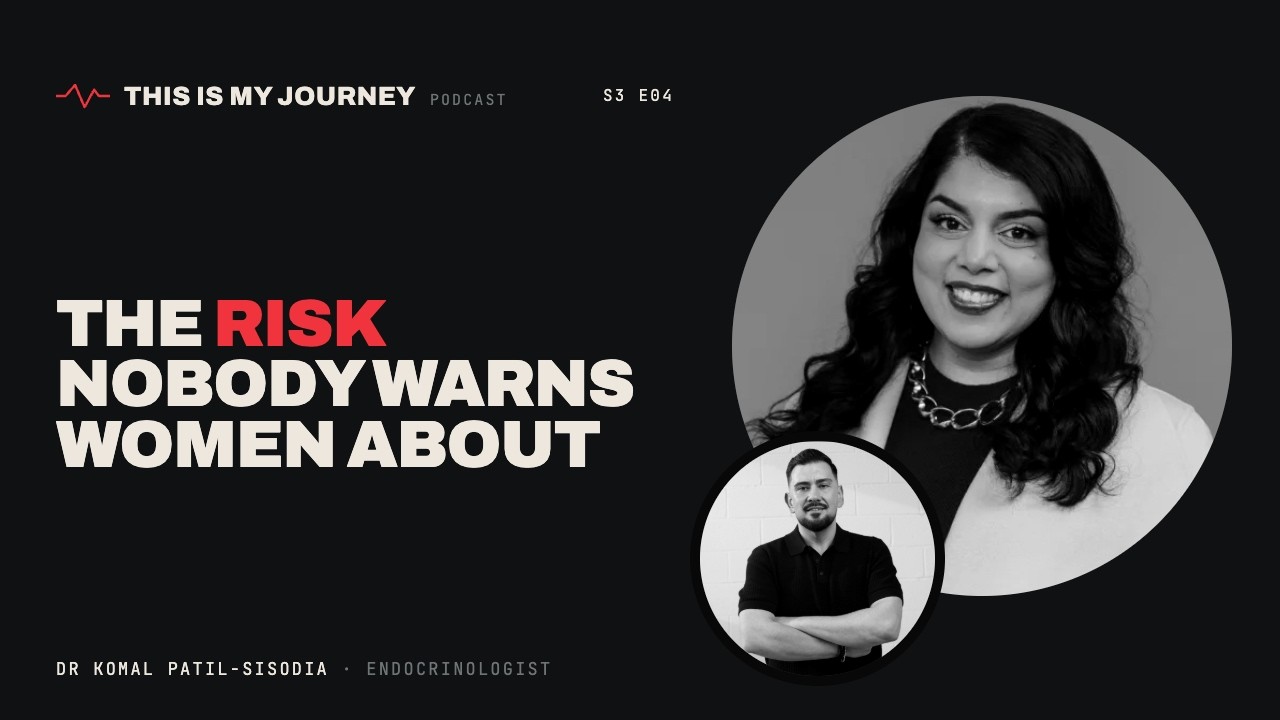
SHOW NOTES
Coronary heart disease kills more than twice as many women in the UK as breast cancer. More than 800,000 UK women are living with it right now. And if you asked most women in midlife what they should be most worried about, I don't think heart disease is the answer you'd get.
Menopause changes where a woman stores fat, how she processes sugar, what her cholesterol does and what her blood pressure does. Weight, hormones and cardiovascular risk are all one system. But they get treated by three different people in three different appointments, if you can get the appointments at all.
In this episode I'm joined by Dr Komal Patil-Sisodia, who is triple board-certified in Internal Medicine, Endocrinology and Obesity Medicine, and is also a Menopause Society Certified Practitioner. She has practised for over seventeen years and is the founder of Eastside Menopause and Metabolism in Redmond, Washington. She's Executive Medical Director of Medical Specialties at a local hospital system, hosts the Clearly Hormonal podcast, and has been named a Top Doctor by both Seattle Met and Seattle Magazine.
We talk about what actually changes in a woman's metabolism through the menopause transition, why heart disease is so badly under-appreciated in midlife, where GLP-1 medications fit for a woman in her forties and fifties, what the evidence says about HRT and GLP-1s together, what tests women should be asking for and aren't, and where to start if you've been told more than once that it's just your age.
SOURCES REFERENCED IN THIS EPISODE
British Heart Foundation, UK Cardiovascular Disease Factsheet, January 2026 (2024 mortality data, ONS)
ABOUT THE GUEST
Dr Komal Patil-Sisodia
Dr Komal Patil-Sisodia is triple board-certified in Internal Medicine, Endocrinology and Obesity Medicine and is a Menopause Society Certified Practitioner. She has practised for over seventeen years, founded Eastside Menopause and Metabolism in Redmond, Washington, is Executive Medical Director of Medical Specialties at a local hospital system and hosts the Clearly Hormonal podcast.
MORE EPISODES LIKE THIS
Loose Skin and Ozempic Face After Weight Loss
S3 E5 · Dr Frank Agullo · 28 min
Hair Loss on Mounjaro: What Actually Helps
S3 E3 · Nyrah Saleem · 30 min
Muscle Loss on Mounjaro: How to Protect It
S3 E6 · Dr Ash Bowden · 32 min
FULL TRANSCRIPT
So today on This Is My Journey, we are joining two conversations that are almost always had separately and shouldn't be. So here is a figure from the British Heart Foundation that stopped me in my tracks. So coronary heart disease kills more than twice as many women in the UK as breast cancer. More than 800,000 UK women are now living with it right now. And yet, if you asked most women in midlife, What they should be most worried about?
I don't think heart disease is the answer that you would get. So menopause changes, you know, where a woman stores fat, how she processes sugar, what her cholesterol does and what her blood pressure does. So weight, hormones and cardiovascular risk are all one system, but they get treated by three different people in three different appointments. If you can get the appointments at all here in the UK. So my guest today is board certified in all of it. So I'm super excited about this conversation.
So let's roll the intro and get into it. When I started, I was on my own. Two years ago, I began GLP-1 medications for chronic obesity with no real idea of what was coming. Not the good parts, not the hard parts, and definitely not the parts nobody warned you about. So I went looking for answers, and what I found was just noise, opinions, judgment, people selling something, and everyone had a take, and nobody had the truth. 126 pounds down, I'm still on this road, still learning,
still working out what maintenance actually means because losing the weight, it turns out, was only half the story for me. I'm Marc and this is This Is My Journey. Every week I sit down with the people I couldn't reach back then. Leading doctors, obesity specialists, psychologists, dieticians, fitness experts, surgeons and the people who actually understand what this medication does to your body. and your mind, and who'll tell you straight. And alongside them, working professionals and people walking the exact same road as you, because their answers, they matter just as much.
Just honest conversations about what this really takes, the science, the setbacks, and the stuff you won't hear anywhere else. If you're on GLP Ones, or you're thinking about starting them, or you're just trying to make sense of it all, this podcast is for you, because nobody should have to do this alone. Not anymore. Welcome back everyone. Today I am joined by a physician who is triple board certified in internal medicine, endocrinology and obesity medicine and is also a menopause society certified practitioner, which is a combination I have genuinely never come across before. Dr. Patil Sasodia has practiced for over 17 years and is the founder of Eastside Menopause and Metabolism.
in Redmond, Washington, where she specializes in exactly the intersection we're talking about today. So menopause, metabolic health and cardiovascular risk. She's also an executive medical director of medical specialties at a local hospital system where she built one of the region's recognized endocrinology programs She hosts the Clearly Hormonal podcast and she's been named a top doctor by both Seattle Met and Seattle Magazine. So Dr. Patel, thank you so much for joining me today. It's a pleasure.
Thank you for having me on your show today, Marc. I think the work that you're doing is fantastic. And for a lot of my listeners who are all Going through what you're about to talk about, I think it's going to be a really insightful episode. So I think for anyone who hasn't really come across your work, especially here, maybe in the UK, obviously I give you a bit of an intro there, but maybe start telling us a little bit more about yourself and about what made you build a practice specifically around the place where menopause, metabolism and heart risk all collide. Thank you so much, Marc.
And I am excited to be here and reaching a whole new group of listeners that I probably don't with my podcast. A little bit about me. I'm an endocrinologist by background, so I specialize in hormone disorders. And my story actually goes back to when I was in high school. When I was in my final year, 12th grade or senior year, as we call it here in the United States, the year before we go off to college, my mother actually was diagnosed with an 80 percent blockage in one of her coronary arteries. And she was only 42 at the time.
I was 17 or 18. And so, you know, not really putting everything together. But I watched her navigate the health care system. And back then, stents were not as good as they were now. And so she ended up having an open heart surgery. This was really the point in her life where I saw her quality of life start to decrease.
And I always assumed that it was because there wasn't a lot of research in women or maybe it was because she was an immigrant woman in the United States trying to navigate a health care system. I just don't know that I really put it all together. And so I set off on my journey. I went to medical school, loved it. specialized in internal medicine. And then after that, here in the States, we do an additional two years of specialization in endocrinology.
Was very happily practicing that until about 2020. And I realized that there was a lot of overlap with what I was doing with my diabetes patients and patients who were suffering with overweight and obesity. So decided to get my obesity medicine board certification because one of my partners was really excited to build a program around that in our practice. And then Probably about three or four years later, around the time I was hitting perimenopause myself, I went to my mom and I said, hey, mom, what was what was menopause like for you? And she said, oh, honey, I didn't have menopause.
I kind of looked at her and I said, you know, that's that's a physical impossibility. And we rewound her story. And it turns out that she had had a hysterectomy. In her early 30s, we didn't have the medical records, so I don't know what was taken and what wasn't. And there is a lot of data now that after you have a hysterectomy, even if you leave the ovaries behind, it accelerates the onset of your menopause. We also know that South Asian women, I'm Indian heritage by background.
also go through perimenopause and menopause at younger ages. And when it started clicking in my brain that my mom had probably had a very early menopause, had never had any care leading up to it, and 10 years later had 80 blockage that really changed the trajectory of her life and her health outcomes, I started thinking about all the other women who weren't getting their health care in the same way. How many people are we missing the boat on when we... don't talk about any of this until the disease is there. And we know that in women, when we start losing our reproductive capability, that is where our chronic disease risk starts increasing pretty substantially. I call it the unmasking of your genetics, right?
So anything that runs in your family history is probably going to be higher likelihood onset for you after menopause. pause. And I see this so frequently in my practice. Women who are doing all of the lifestyle interventions that they've always done, keeping a good diet, moving their bodies, trying to get good sleep, nothing really changes. And then all of a sudden they're told at their annual physical, oh, your cholesterol is a little high this year or, oh, hey, you know, you've gained five pounds or your blood sugar is going up. And
We tend to brush these things under the rug because they are difficult conversations and nobody really likes to hear that something is shifting in their health because it can be scary, it can be overwhelming. And I think we do a disservice to women that we don't really talk about these things. So this is how my practice kind of came together. I saw this big gap of women who were not getting the conversation they deserved. The other thing I was noticing in my practice is women who had pre-existing metabolic disease like PCOS, which is now renamed to PMOS, pre-diabetes, type 2 diabetes.
All of these things were type 1 diabetes even. All of these things were accelerating as they hit perimenopause and they were getting harder to control. And all of these things are things that increase your lifetime risk of heart disease and stroke. So I saw a big gap here that we needed to start talking about. And that's how I built my practice. No, that's absolutely amazing.
In a way, you know, it's all stemmed from your personal experience and everything has led to that. I suppose there's a real connection there to it for you. So I suppose a lot of people that's listening will be going through something similar themselves. So let's start with the big one. What actually changes in a woman's metabolism through the menopause transition? And why does it hit weight so hard so fast?
Yeah. And I think, you know, I want to preface anything I'm about to say with the fact that women were not included in medical research until 1993. And we just don't have a ton of studies. So some of this is going to be some studies that we have versus what I've observed in my clinic. And I'm going to try and point out the difference between the two. One of the things that we do know about women who are going through menopause is that as the reproductive hormone levels decline, especially estrogen,
We are having a harder time holding on to our muscle mass, and it is much easier to start putting on fat mass. And the reason for that is actually kind of interesting. It's like an evolutionary biology type thing. We know that fat tissue produces estrogen. So as the ovaries are shutting down, which is what they've been programmed to do, right? Women are built with a certain lifespan on their ovaries, and they age at different rates in different women.
Absolutely. As those estrogen levels start declining, the body starts thinking, gosh, I have to figure out a way to save myself and provide more estrogen. So we gain fat mass a little bit more easily. And it tends to be what we call visceral fat. So that is the fat that is around the central part of your body, around your belly, around that particular area. And that fat is different than what you would gain on your arms or your legs.
In those areas, we see fat mass just be under the skin. In the abdominal area, what we see is it actually goes inside your abdominal cavity and it starts packing around your vital organs. And we call that visceral fat. And visceral fat tends to be much more inflammatory and also increases the risk of high blood pressure, high blood sugar, high cholesterol. So we end up in this situation where evolutionarily our bodies are trying to save themselves, but it ends up turning into a disease. I think you did a really good thing there in terms of really
plain English because I think this stuff can be quite hard to understand for the general person. I suppose I've just learned something and I've been in this and doing this for a long time, but just that explanation was amazing. Your work there is at that intersection of menopause and cardiovascular risk. So why do you think heart disease is so badly underappreciated by women in midlife when the numbers are what they are? That's a great question. I think, again, it goes back to the fact that we just don't have as much research as we do in our male counterparts.
I think it's also that there are so many different shifting eras of a woman's life, right? You have childhood where things are relatively calm. puberty where the hormones take off, those peak reproductive years where if a woman is choosing to, she's trying to start a family, then you go from that into settling into your postpartum hormones, into perimenopause, then your periods stop, and then you're in postmenopause, right? So it's almost like every 10 years we have to realign with what our bodies are doing and And that becomes hard. And I think because of those switches that women are going through often, we actually become more resilient to it, which is a superpower and an Achilles heel at the same time.
Right. Yeah. When you can put your head down and power through anything. you're not necessarily paying attention to how your body is changing, right? And then you layer on top of that the societal expectations for women, the cultural expectations for women, depending on what your family's background is. And you are tasked with trying to have it all, right?
If you're a career woman, you're trying to focus on your career. If you're a stay-at-home mom, you are on 24-7. And I guarantee that is harder because I tried it for a little while and I didn't get it. There are a lot of things that are landing on your plate and a lot of expectations about showing up as the good mother, the good wife, the good sister, the good daughter, and the good friend and trying to balance everybody's expectations. And we often put ourselves last on the list. And because of that resilience, we're not paying attention to our symptoms and the changes in our bodies anymore.
And there is a critical time period between pregnancy to menopause where there are different markers where metabolic risk increases. So for our listeners who are tuning in right now, if you are in those peak reproductive years and you are having babies, there are certain things that can happen during your pregnancy that will increase your lifetime risk of heart disease and stroke. Things like gestational diabetes or gestational hypertension, where you have high blood sugars or high blood pressure during pregnancy. Those are actually cardiovascular risk markers. And we don't counsel women about that when they're going through it during their pregnancy because we're scared of upsetting them during their pregnancy. And then after you have a baby, trying to find the time to get back in to see a health care provider.
I mean, your time is gone, right? So we miss the boat. A lot of women who have gestational diabetes don't end up going back to their doctors to have additional testing to see if the diabetes persisted past pregnancy. Sometimes, you know, they need additional monitoring for their blood pressure and it may take longer for it to resolve or it may not resolve entirely. And again, you're missing these areas where you can intervene right there. And, you know, some women make it through all of that.
They do fine until perimenopause, but then they're busy, you know, trying to build their careers or trying to get their children out of the nest or whatever the next step may be. And again, there is a lack of follow through and not Not as a blame thing at all. It is just where is the time, right? And where am I on my priority list? And then you layer on top of that the fact that a lot of physicians after the Women's Health Initiative was released in 2002 just did not have women's health and perimenopausal transition as a big part of their education.
You end up with this void where there is like a 20-year intervention period and we are doing nothing. And that is, I think, why it is so hard. Now, it's so interesting there just hearing you talk about the research. And this might not be fully accurate, but what I'm getting is that the whole menopause thing is very new. For a lot of people, they might assume that it's something that has been around for a long time. And obviously it has.
But yeah. actually the studies there and the changes that happen, it's something we're still all learning about. And obviously, you know, I am male, so, you know, I can't relate in that aspect, but I think a lot of people that I do speak to, you know, a lot of women that are messaging, you know, they'll, they will talk about these changes that they're going through right now. And. I think, starting GLP-1 medications and how that's interacting with that. So it kind of is leading me on to what I want to ask you next.
So where do GLP-1 medications fit into that picture for a midlife woman? So, you know, is this a different conversation for her than for a 30-year-old or is it the same conversation? Yeah, I mean, I think that it comes down to what metabolic risk the person who's coming into my office is walking in with. Right. I have some patients who have a great family history where people live into their late 90s, early 100s, and they don't have a lot of chronic illness that runs in their family. And they actually do pretty well.
And so GLP-1 may not be needed. I usually always preface it with people should be struggling with overweight or obesity. right? Or there should be some other, you know, there are newer indications that are coming out around heart disease, around liver disease. There are certain... criteria that you have to kind of meet before that becomes a conversation.
But for the woman who's walking into my office who is struggling with overweight or obesity or prediabetes or diabetes, GLP-1s are going to be a part of the conversation. But what I find in the average woman who may not have those things, who may have gained 10 or 15 pounds, and they're having really substantial symptoms from their menopause, is that Sometimes treating the menopause symptoms can help them actually start to get better sleep, be able to move their bodies, be able to focus on, you know, meal prep and all of the other things they were doing before that may have fallen by the wayside because they're feeling so terrible now. And I can think of a few people who've come to my practice. where there is a weight struggle, there's some high cholesterol, high blood pressure, and we think, okay, well, you know, we can potentially work with a GLP-1, but the menopause symptoms are so bad that let's start with the hormone therapy. And there's one person in particular that I'm thinking about who I think maybe had 10 or 15 pounds to lose.
We started her on hormone therapy. She came back to my office eight weeks later and she said, you know, I don't think I need the GLP-1 because I my joints don't hurt anymore. And I've actually just started walking and going to the gym. And I've lost six pounds since I saw you eight weeks ago, which is remarkable. Right. So they may not need it.
And I think it becomes very important to have a conversation with a woman fully around what her health has been up until that point. what her family history is, if there are any personal risk factors there are, and then what the health goals are, right? First and foremost, I want people feeling well enough to be able to engage in their health care, right? And we both know from all the conversations and the work we've done that GLP-1s don't necessarily work well unless your foundational lifestyle pieces are in place, right? They're a great medication, but they can actually cause harm if you're not sure. eating enough protein or you're not moving your muscles enough or you're not focusing on your sleep, sometimes they may not work at all if you're not doing any of those things.
So I, you know, I try and sort it out in a way for my patients where what we work on comes down to little bite sized chunks because you also can't change everything. You'll overwhelm somebody with a mountain of information. But I think it really, you know, again, that metabolic health piece, which impacts the cardiovascular disease, that's where I really focus on and see if there is a need for GLP-1s in the treatment plan. for anybody that's listening, because some people might just assume that, I don't know, they might not think about the likes of the hormone replacement therapy or whatever. And then they're maybe starting a TLP1 and there could be other things there. Yeah.
And actually, that brings me to a really interesting point. So one of the most common symptoms that women have in menopause are hot flashes, right? And hot flashes, if they are severe and frequent, can actually be a cardiovascular risk marker. The interesting thing is that the hot flash potential and the temperature regulation is controlled in our brain in an area that we call the thermoregulatory zone. There are GLP-1 receptors in your thermoregulatory zone. And so sometimes my patients who start GLP-1s, they may actually have some relief of their hot flashes.
and not realize that maybe this could also still be menopause because the GLP-1 is acting at that level. But, and this is going back to what we talked about in the beginning, because we know that fat mass produces estrogen, they'll have relief, but then as they start to lose the weight and the fat mass goes down, the hot flashes come back. Right. And so this is where I really counsel my patients on paying attention to your body. You are the one who is living in it every single day. You know what symptoms are happening.
I don't live there. You have to tell me what's going on. And we can often find patterns that have reasonable explanations that don't require very expensive tests, but just by talking through the history and the plan of what we've been doing and how that may play out for you. Well, that's super interesting. Kind of related, and you did touch on that there. So HRT and GLP-1s together, you know, a lot of women are on both or wondering whether they should be.
So it kind of, we're talking about that at the minute. What does the evidence actually say and what do you tell your own patients? I think... We need a lot more data on this. There was a small observational study that came out that looked at around 100 women, and it compared women who were on terzepatide versus terzepatide plus hormone therapy. And the observational data showed that there was maybe a 4% increase in weight loss in the women who were on the combination.
But that is an observation. It does not mean that we flushed it out in a randomized control trial. Could it help? Absolutely. Is it absolutely gold standard for what everybody should do? We don't know that yet, right?
So this is where I really talk to women about, again, having that very clear assessment with your health care provider team and understanding whether you have metabolic risks. What do you need to be working on for that? And then also, you know, in terms of your hormone therapy symptoms, what are hormone symptoms for midlife? Do you need hormone therapy? Because you will often need both for different reasons.
Can they work synergistically? Possibly. But you really should be tailoring your therapy to what your body needs and what your symptoms and your past history are dictating for you. Yeah, I think that's really good, good advice. You are building a practice closing a systemic gap in midlife women's healthcare. So what is that gap like concretely?
You know, what are women being sent away without? Everything. Sounds terrible. But, you know, we do a good job of breast cancer screening, of colon cancer screening, of prostate cancer screening for men. But we're not doing metabolic health screening in the way that I think it needs to be done. And one of the things I've been working on for the last year, and I'm hopeful to get it out later this year, I'm working with some software developers and
It's a lot more complicated than I thought it would be, but I've created a health assessment that I'm calling the Midlife Health Compass, where it allows a woman to go in and put in what her demographics, meaning like age and ethnic background and all of those things with her reproductive history, menopause symptoms, and then any other cardiovascular risk factors that come out. gives her kind of an idea of where she's at in her perimenopausal or midlife journey and also gives a signal score for what cardiometabolic risk might look like, right? And that is, I think, where we have a really big gap. If I go in for my annual physical, it's up to me to bring up things. We don't have a standard way. for our GPs or our primary care physicians here in the United States to be able to do that assessment.
And, you know, I don't know firsthand what the health care system is like in the UK, but I can tell you in the United States, it's gotten more and more difficult to get visits. And you really only have maybe 10 or 15 minutes with your primary care physician, maybe 20 or 30 if you're lucky, to talk about all of these issues. And if you have a laundry list of things that you need to get through, It's not going to happen. And then we have not a robust education around women's health in general. And a lot of women end up leaving the primary care or GP's office feeling completely dismissed.
And it was interesting. I was at the Menopause Society Conference last year here in the United States, and they presented some really interesting data that the most common symptom of perimenopause is I just don't feel like myself. What does that mean? Right. That could mean a million different things. Yeah.
But it's the most common. Right. How do you navigate that in a 10, 15, 20 minute visit? Yeah, there's a lot to unpack there. Yeah. And yeah, big time.
There's a lot to unpack. So I think really, you know, what I'm trying to do in my practice is create a standard around what it is I want to look for in each patient that's coming in to see me based on their history. Right. And that's really I mean, if you think about the backbone of medicine, that's not a revolutionary new concept. It's really how we're supposed to be treating people. Yeah.
We just haven't set the standards for women for some of these things, right? They're there, but we don't get to all of them. Or we don't know how to put it all together in a way that you can get what you need at a visit. Yeah, no, well, I think first off, that assessment that you're working on, that sounds like it's going to be something that every woman will want to use because I think, There's a real lack of information and real lack of support. And I think something like that would really help guide, you know, women to understanding where they are on that journey.
So whenever that does come out, please do circulate it to me because I would love to share with everybody too. Yeah, no, definitely. So I suppose moving on from that then, how much of what women are told is important? weight, just lose some weight and you'll feel better is actually hormonal or metabolic or cardiovascular or being missed altogether. Say like almost all of it. Yeah.
Would be my guess, right? Because I think, and you know this with the work that you do, just breaking down the stigma and the barriers around access to care for overweight and obesity is so difficult. We have so many biases towards people who struggle with overweight or obesity, right? And I'm as much a doctor as I am a patient. Weight has never been an easy thing for me.
And I think that's why I take an interest in this type of work, because what people don't understand sometimes is that your genetics are the hand of cards that you're dealt with. Right. Imagine you're sitting at a card game. You don't have a choice to swap out any of the cards. You got to play with the hand of cards that you're dealt. And if we can teach people how to navigate those things, how to one first understand the cards that are in your hand.
And then what options exist out there and that can help you navigate that? I think we then start addressing the hormonal, the metabolic, the cardiovascular risk. But a lot of times because people don't know how to sort through that hand or there are a lot of biases or judgments that they're feeling from their peers, their family, their just society as a whole, people may not actually go seek out that help. Right. And especially for a woman who's told repeatedly it's in your head or it's, oh, this is just a part of getting older or just lose some weight and you'll feel better.
Those are not answers. Those are not solutions. It's not helpful. It's a trite statement that makes you feel bad about yourself. Right. Yeah.
And how do you expect anybody to come back and reach out for help if that's the messaging that they get consistently? They're not going to. So I think we miss all of it almost just because women are so often dismissed in a health care provider's office. I would echo what you've said there just based on personal experience in terms of, you know, women in my life and stuff. That's, that's exactly what they would, they would say that. Um, so I suppose really what should a woman in her forties or fifties be getting tested for that she maybe otherwise isn't.
So if she walked in to her doctor tomorrow or if somebody came in to you tomorrow, you know, what would she ask for? So this is a question I get often, and I will start with the hormone question, right? Because everybody says, well, can you test my hormones, right? And that is not always the most helpful thing because we go through so many hormonal shifts just to have a period. So nothing is stagnant in that 28, 30, whatever day cycle it is. And when you're continuously having periods, it's just kind of like, you know, the bar is moving all the time.
So getting a point where it is stable and you can check your hormones and it can tell you where you're at in perimenopause, that's not a thing, right? The only way we can confirm you're in menopause is one year after your final period, your hormone levels flatten out and they reach their lowest point. And that's really where it's reliably you can say with a lab test. So I would say a symptom assessment of the symptoms you may be having in midlife.
So there are some scales that are used. There's the Green Climacteric Scale, which is 21 symptoms of menopause. And the scale has been validated. And you can get a score from it that tells you whether you're symptomatic for menopause. There's also the menopause rating scale. This is a 14-question questionnaire about 14 symptoms.
And again, there is a score cutoff that tells you whether you're having symptoms of perimenopause. And, you know, so many women feel validated taking that. The one thing I will tell women, though, is when you're taking it, make sure that you are being accurate with your symptoms. Because I've actually watched people who didn't complete the paperwork in time in my office take them. And you can see the wheels turning in somebody's head.
Well, I don't want to seem like a complainer. Am I mild? Am I moderate? I'll just go ahead and mark mild, right? Because maybe it's really not that bad. Maybe I'm just being a complainer.
And you see this interior monologue happening and they pick the lower number of the two and you're under reporting your symptoms when your symptoms are, in fact, very real. And we need you to be forthcoming about that. There's not going to be judgment there. For me, for my patients, when they're coming in and telling me what their symptoms are, I'm going to try and approach it from a place of understanding where we can work towards a solution. So that'll be one thing. So if you're in midlife and you are feeling like you're in perimenopause or approaching that final period, make sure you take that symptom assessment to know whether you need hormone therapy or not.
And if you can't get hormone therapy, at least you have an assessment of your symptoms and you can start exploring non-hormonal options. From a cardiometabolic standpoint, I'm an endocrinologist at heart. So, you know, checking for a fasting glucose, hemoglobin A1C to look for prediabetes or diabetes, cholesterol panel. The American Heart Association recently updated their guidelines to also include some additional tests. which are a C-reactive protein, a lipoprotein little a, and an apolipoprotein B. These are not part of the standard cholesterol panel, and these three are all independent risk factors for cardiovascular disease.
So you could have a totally normal lipid panel, and this is actually what happens to my mother. She had the elevated lipoprotein little a, and people didn't know about it for years. The other thing, you know, The other thing that I often tell women is, you know, if you're having elevations of those things and you try diet and exercise and lifestyle changes for a while and it hasn't moved the needle in three months, it's probably genetic. And this is why medicine and science exists. And there is no shame in asking for help with a medication because it's going to prevent you from having that heart attack that nobody wants to have down the line.
And then I also recommend checking thyroid tests. So a screening, especially if there is a high risk of thyroid disease in your family, it's estimated that one in four women will develop some sort of thyroid dysfunction after their final period. And so that's a pretty substantial number. There's not standard screening guidelines around it. It's really risk-based screening, which is very vague. And sometimes women don't get that, right?
And when you're feeling fatigued, there are so many symptoms of thyroid disease that overlap with menopause. I joke it's almost like two concentric circles. other than the hot flashes and like the sexual health symptoms on the side, all of the other symptoms are almost exactly the same. So you need to be able to dissect what is happening there. And then lastly, if there is, you know, a lot of women will come to me with hair loss, There are nutritional reasons for hair loss like vitamin D deficiency, B12 deficiency, iron deficiency.
Iron deficiency and all of these other deficiencies can also cause fatigue, you know. So I think that getting that as a starting point is good. And then if the hair loss continues going on and you can't find a medical reason, then going and talking to your dermatologist about it. that. And so those are like the basic things. And then I pick things based more on symptoms, right?
If women are really having kind of more of a male pattern baldness or they're noticing more facial hair or body hair, I may check testosterone levels and other androgen levels, which are the hormones that can cause those types of symptoms. But I don't do that in everyone. So it's really the first set that I talked about that is, in my mind, the standard that every woman should be getting. At that initial visit. And, you know, then if the genetic markers aren't elevated, you don't necessarily need to keep repeating those. But all of the other ones you should probably repeat on a yearly basis to make sure you're not developing an issue.
Yeah, well, I think that like all them pointers will all be really helpful to anybody. Yeah, no, well, anybody listening, I think it's, you almost don't know where to start when it comes to this kind of stuff. So it will be super helpful to anybody that maybe this is only brand new to them and they're going through this. So yeah, thank you so much for going through all that. So I know you do talk about a lot of this anyway on your Clearly Hormonal podcast that you do yourself. So, you know, your podcast itself is built on myth-busting because obviously very like, I suppose, my own, you know, there's so much, you know, you know, misinformation out there and that kind of thing.
What is the most persistent myth you know, let's put it to bed about midlife women's hormones that you'd most likely like to see the back of? I think it's the assumption that hormones are going to be a silver bullet for everything that's wrong in your life. And that's not the way it is. Right. Even in the weight management space.
Right. When we talk about obesity care and, you know, things like that, it's, GLP-1s are not the silver bullet. You still need to look at all of these other things. And so when you are started on hormone therapy, if that's something that's available to you and you choose to employ, if your symptoms are not getting better on the hormone therapy, you need to go look for other causes, right? Especially if your doses are adjusted and you had partial relief for a while and now you're having new symptoms come up.
Sometimes it can be that you need more hormones, but sometimes it can be an entirely different issue. a week in my clinic where, you know, somebody, I had patients, like three or four patients who came in like this. One had a thyroid disorder. One had a really severe iron deficiency. One had, and this is a neurologic issue that popped up that ended up needing surgery, right? So there are so many different things that it could be.
And Thinking that this is the one problem or and hormones are the one solution is such a myopic view, right? We need to really broaden our horizons and not forget about all the other stuff that can also potentially go wrong. You're doing yourself a disservice if you think that this is the only and one answer. And I think, you know, midlife women's health having a moment right now is a double edged sword, right? So many women are getting great information and they're going out there and they're being more proactive about their health.
But there are so many women who feel like they're missing out. And this FOMO, you know, fear of missing out, we call it here in the States, it really ratchets up, right? And people feel left behind or they feel like somebody is withholding information from them or there's some big great secret to this fountain of youth that we can hold on to forever. That's not reality. Right. Everything is very individually based.
We're also genetically diverse in terms of what our backgrounds are, what our family histories are. What works for me is not going to work for the next five women walking down the street. It may not. Right. We may all have slightly different plans and that's OK. But I think we just have to be careful about how much we tout hormones as the be all and end all of everything.
Yeah, no, I think that's very honest. So I think for a lot of women listening to this who maybe is perimenopausal, you know, carrying weight, exhausted, and has been told by more than one doctor that it's just her age. Where does she start? I know. And this is the hard thing, right? Because health care access is a big problem, I think, in both our countries.
And I think really going and finding a menopause certified practitioner in the in the United States, we have our website. That's menopause.org. You can go in there and look for health care providers in your area that may be menopause certified. If you're not getting that help from your primary care organization. or GP, right? There's the British Menopause Society.
They have great information and they have great resources for patients if you go to their website. So that may be a great place to start just to start educating yourself. I would stay away from, you know, blogs and stories of one and, you know, like this is my experience. So this must be everybody's experience type stories. If it sounds too good to be true, it's usually too good to be true. So I would say, you know, make sure you're getting your information from credible sources.
There's a lot of misinformation and there seems to be a growing distrust of science, which really scares me a little bit, honestly. Yeah. But but it's where we are. Yeah. And I suppose from my own experience and sharing my own weight loss journey online, like, you know, I know social media especially can be, you know, there's so much misinformation on them platforms and everybody's experience is different. So you should never take one person's experience as what your experience will be like because everybody is so different.
And I think that's where it needs that personalized approach with somebody like yourself that is able to work through that with you. And I think that there are amazing influencers out there, such as yourself, who are dedicated to making sure that good information goes out, that everybody understands that, you know, one person's journey is not everybody's journey. And I really respect the work that you've done and the content that you put out. I think it's excellent. And I really enjoyed listening to your podcast over the last few weeks in anticipation of us recording today. So...
It's been, you know, I think that there are incredible resources out there. I've actually been toying with the idea of like starting a section on my website for things that I, you know, vet and trust and would recommend to people and just like posting things up there. So if you don't mind, I'd love to put your. podcast. Oh no thank you so much. It's one of them things I think it's this because there is so much misinformation I think that's where I enjoy doing this because I want to give people the right information.
There's so much out there it's just about getting clicks and views and follows and all that. And it's not real. Like, that's not reality. And I think, you know, people deserve to be given the right information. And it's, yeah, it's a scary place, I think, on the internet in general.
It can be, especially when you post something that rubs people the wrong way. Like, I think I made a post about the FDA here. They had a committee that voted to allow compounding pharmacies to make gray market peptides, which really don't have a lot of evidence-based data on them. Ooh, some of those comments were rough. I had to turn off my social media for a week and then I thought, you know what?
I'm gonna channel my inner Cardi B and thank my haters because they're driving the algorithm and just not respond to any comments. Yeah, no, I am completely with you on that. I am actually related to this conversation I had posted. It was last year. I posted a video about again, just trying. I do always do my research, look it up, you know, about, you know, women going through menopause on, you know, this journey with GLP ones and just the little information that I could find available to signpost people to certain things and yeah, some
I don't know, woman created a whole video. Why was I creating a video about menopause, being a man and all this? And I was never saying it about me or telling people what to do. It was only signposting people's information and all this. But you know what? You can never win sometimes.
You can't. I think it's just, you know, these people exist. Yeah. And it's interesting, you know, just to see how technology has taken away that accountability, right? We're not necessarily the kindest to each other anymore. No.
And that definitely manifests on social media. So I try and keep my limitations on how long I look at those comments and how long I'm there. Yeah. Yeah, no, well, definitely the content that you put out, you know, I've seen a lot of it. And I think, you know, it's anybody that is putting out information that is factual and it's, you know, verified, I think, is what should be on social media and not some of the stuff you see. But anyway, that's personal opinion.
And yeah, some people might disagree, but sure. I suppose really finally just to finish up because I have enjoyed this so much just hearing all what you've had to say and all that information has just been incredible and I know everybody listening will find so much. benefit to it so i think really what i would love to do is for you really just to signpost a lot of people i will have all your details all your links to everything in the captions because i want everybody to go follow you do you know everything that you've got to offer i suppose really just if you want to let everybody know where they can find you you know where all your information's really going to be and where they can listen to the podcast Yeah, sure. So you can find me at eastsidemm.com. That is my website for my clinical practice.
And I have links there to my podcast. My podcast is also available pretty much anywhere you stream, Amazon, Spotify, Apple Podcasts, any particular platform. It should be there. I am on Instagram and TikTok as at Dr. Patil Sasodia. No hyphen in there, just all. letters I shared with Marc earlier, the story behind why I hyphenated my name.
That's another soundbite for another day. But you can find everything there. The Midlife Health Compass, when it does come out, will be linked to that website. It will also be at midlifehealthcompass.com. I'm working on figuring out how to get that. But the assessment itself will be free for women to take.
And it It actually gives you a download where it doesn't really capture any of your data right now. But I am trying to figure out a way if I can build a HIPAA compliant platform to start collecting women's health data that we can look at in aggregate, just knowing that there isn't any study that's been done out there. But the survey on my website will be free to all women. I built it in honor of my mom because she did not get the care that she needed. And it gives you a punch list of things that you should talk to your doctor about.
But then on the bottom half of the PDF, it actually gives the clinical evidence so that if your doctor wants to look at it and to all my health care colleagues, I'm not trying to throw anybody under the bus. I'm just trying to make a tool that we can all use. And I'll have some educational content around like how I put it together and why. coming up in the future for all of my colleagues that are out there. So, you know, it's not something that I am trying to build it with intentionality where it can be useful to health care providers and to women and make that visit where you may be told it's just part of getting older, a much more fruitful visit because you actually know what to go ask. Yeah, no, well, Dr. Patil Sasodia, thank you so much for sharing all your insights and all your learnings with everybody.
It's been an incredible episode. Yeah, there's no other words to describe it. Thank you so much for sharing all that information. And... Yeah, would love to have you back for more conversations down the line. I think, yeah, you've you've so much to share and your knowledge is amazing.
And I'm sure, yeah, I would encourage everybody to go and touch base with you, follow you and start taking all the knowledge for themselves from all your content because it's absolutely fantastic. Thank you so much, Marc. I really appreciate you having me. And I feel the same about yours. I've learned so much just hearing from the different guests that you bring on and the experiences that people have. And I would encourage you to keep doing what you're doing.
It's phenomenal, phenomenal content. And I'm honored to be here today as your guest. Well, thank you so much. Thank you.