


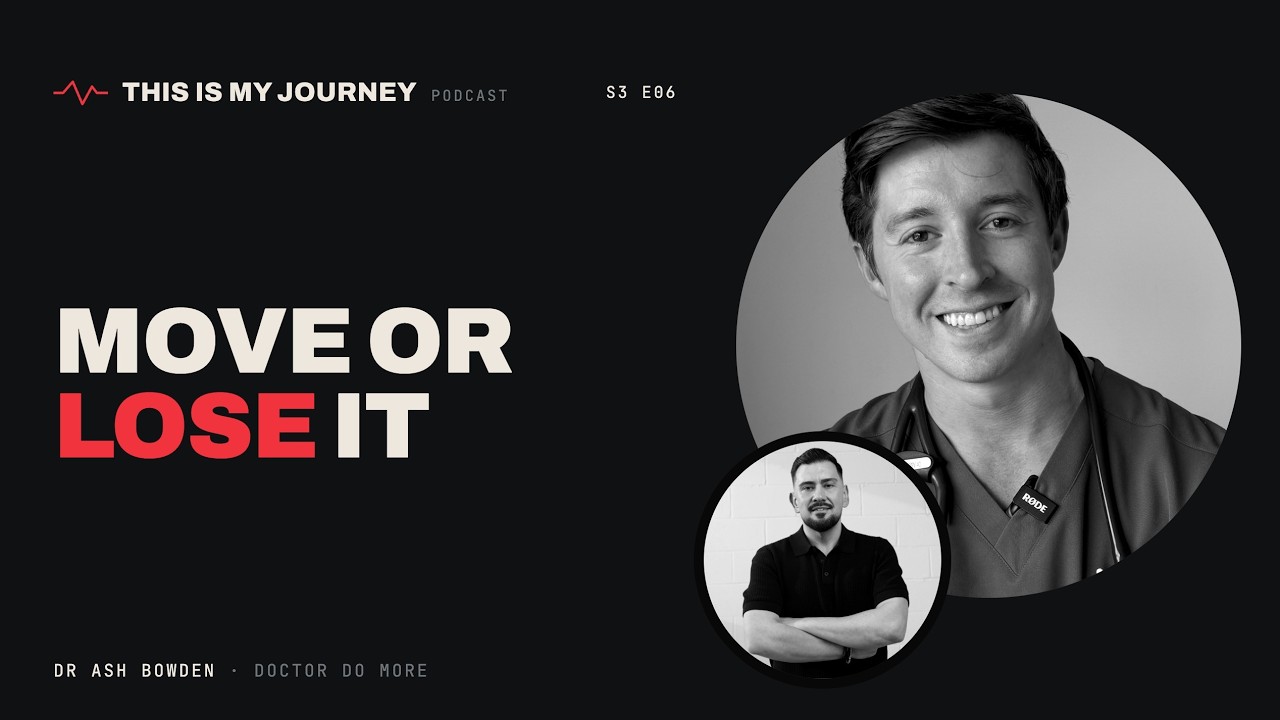
SHOW NOTES
Sport England's Active Lives survey puts it starkly: 11.8 million adults in England, nearly one in four of us, are classed as inactive. That means less than thirty minutes of moderate movement in an entire week.
Now put that next to what happens on GLP-1 medication. In the STEP 1 trial of semaglutide, roughly 39% of the weight people lost was lean mass. Not fat. Muscle and bone. The scaffolding you need to hold your body up for the rest of your life. So the number on the scale goes down, everyone congratulates you, and something you can't see is quietly going down with it.
In this episode I'm joined by Dr Ash Bowden, a UK-trained, Australia-based GP with a background in Sport and Exercise Science, known online to a lot of you as Doctor Do More. He's passionate about lifestyle medicine, physical activity and health literacy, and he makes movement feel like something you do rather than something you're told off about.
We talk about what's actually happening to muscle and bone during rapid weight loss and how worried people should be, what "protect your muscle" looks like in practice on a Tuesday evening when you're exhausted, how to start moving when you have no energy in the early weeks, where to begin with resistance training if a gym feels intimidating, whether walking is genuinely enough, what movement does for maintenance that food alone can't, and where to start if you have a bad back, sore knees, a disability or a lot of weight still to lose.
SOURCES REFERENCED IN THIS EPISODE
Sport England, Active Lives Adult Survey (Nov 2024–Nov 2025, published April 2026)
Wilding et al., STEP 1 trial, New England Journal of Medicine, 2021, body composition analysis
ABOUT THE GUEST
Dr Ash Bowden
Dr Ash Bowden is a UK-trained, Australia-based GP with a background in Sport and Exercise Science, known online as Doctor Do More. He is passionate about lifestyle medicine, physical activity and health literacy, and makes movement feel like something you do rather than something you are told off about.
MORE EPISODES LIKE THIS
Telling People You're on Mounjaro: Dating and Identity
S3 E7 · Dr Treena Orchard · 31 min
Loose Skin and Ozempic Face After Weight Loss
S3 E5 · Dr Frank Agullo · 28 min
Relationships on Mounjaro: When One of You Changes
S3 E8 · Jonathan Van Viegen · 22 min
FULL TRANSCRIPT
Today on this is my journey, we're talking about the advice everybody gets and almost nobody follows. So Sports England's active live survey put it starkly, so 11.8 million, nearly one in four of us are classified as inactive and that means less than 30 minutes of moderate movement in an entire week. Now I put that next to what happens on GLP-1 medications. the weight people had lost was lean mass not fat so that's muscle bone the scaffolding you actually need to hold your body up for the rest of your lifetime so the number on the scale goes down and everyone congratulates you while something you can't see is quietly going down with it so my guest today has built his entire mission around fixing that without the lecture. So let's roll the intro and get into it.
When I started, I was on my own. Two years ago, I began GLP-1 medications for chronic obesity with no real idea of what was coming. Not the good parts, not the hard parts, and definitely not the parts nobody warned you about. So I went looking for answers and what I found was just noise, opinions, judgment, people selling something and everyone had a take and nobody had the truth. 126lbs down, I'm still on this road, still learning, still working out what maintenance actually means because losing the weight, it turns out, was only half the story for me. I'm Marc and this is This Is My Journey.
Every week I sit down with the people I couldn't reach back then. Leading doctors, obesity specialists, psychologists, dieticians, fitness experts, surgeons, and the people who actually understand what this medication does to your body and your mind and who'll tell you straight. And alongside them, working professionals and people walking the exact same road as you. Because their answers, they matter just as much. Just honest conversations about what this really takes. The science, the setbacks and the stuff you won't hear anywhere else.
If you're on GLP-1s or you're thinking about starting them or you're just trying to make sense of it all, this podcast is for you because nobody should have to do this alone. Not anymore. Welcome back everyone and today I'm joined by a UK trained Australia based GP with a background in sport and exercise science who is better known online to a lot of you as Dr. Do more. So Dr. Ashboden. He's passionate about lifestyle medicine, physical activity and health literacy. And in his own words, when he's not working, you'll find him exercising or overcomplicating a DIY project, which is what I've seen recently on his socials.
So he's exactly the voice I wanted for this one because he makes movement feel like something you do. rather than something you're told off about. So Dr. Ash, thank you so much for joining me today. It is great to have you talking to me from the other side of the world. So I appreciate you staying up a little later, probably after after work than you normally would. Thanks Marc.
It's great to be on your podcast and excited to talk about this. Definitely a subject I love to talk about. I suppose really for anyone who hasn't come across your page because you're growing on social and yeah, I think it'd just be great to tell everybody a little bit more about yourself. Just how a GP ends up as Dr. Dumour and what made you decide that movement was different. the message you wanted to build your platform on? Well, it started when I was in the UK working in intensive care.
I got the privilege of working with a consultant who was doing exercise testing and was able to educate me on the value and benefits of exercise. It felt like a light bulb moment. It was crazy how valuable movement and physical activity can be. And, you know, I've been through medical school. We're taught to prescribe things and treatments. And there was this treatment or intervention that can do so many things for our health, for our mental health and physical health.
So it just sort of started a fire in me. And when I came out to Australia, I started meeting anyone and everyone that was active. So I'd go to gyms, Pilates studios, yoga studios, pole dancing, kayaking, you name it. If it was active, I'd go there, try it out and sort of try and practice what I was preaching. And I met the most incredible people and everyone that is in the movement space, whether they're trainers, coaches, gym owners, they all seem to get it benefits so much.
And then depressingly, I realized how little doctors and healthcare professionals really understood about movement. The evidence is flawless. You struggle now to find anyone that can't tell you about the evidence of movement, but then actually putting that into practice has, from my experience especially, been really quite depressing. So I've sort of seen this need. I see the feedback in people when I talk about movement and it's, yeah, kind of just, I'm not sure how Dr. Do More came about, but it was a, I'm going to practice doing more. That's where I am now.
Really, I suppose to start off with then, you know, let's start with that muscle question. So the conversation around muscle, it frightens people because obviously that's a lot of what we see on the headlines and things, you know, about people losing muscle. So when somebody loses weight, fast on the likes of a GLP-1, what actually is happening to their muscle and their bone and how worried should they be? I think this comes to some of the basic principles when we talk about weight loss. And one of the key things is the difference between weight and fat and muscle and bone.
So often when I'm talking to patients, we're talking about weight loss. But really, we're trying to lose fat and we're trying to maintain the healthy things, which is muscle, bone, connective tissue. And so trying to differentiate that first of all so that we can understand the goal. And when it comes to then losing weight, the way our body sort of works is if we don't have enough energy for the activities that we're doing in a day, then it's going to find that energy somewhere. And ideally, it will choose fat first. But if we're really low on energy or there's a big difference,
it's going to start breaking down muscle cells and taking the fluid and energy from the muscles. And if we're in a real deficit, again, that can happen with bones too. And that's when we see that, like you said in the beginning, that number on the scales goes down. But actually, if we're losing bone density and muscle and fat, then yes, we're getting lighter, but we're getting weaker and sort of frail. Every clinician I see, you know, says the same three words to these patients, patients like me, you know, protect your muscle. But also almost nobody really explains what it means on a day like today, just a random day when you're shattered and you're tired.
what does it actually look like in practice? And I think this sort of builds on that first question. When we're talking about looking after muscle, maintaining muscle, the example that when I'm talking to patients that often helps is when we talk about old age. Lots of people can understand what happens to us as we age and people become weaker and frail if we're not moving and maintaining muscle and maintaining bone. And so this can happen early with the GLP-1 medication because, yes, we're losing weight, but if we're losing those things that keep us fit and functional, that's the sort of frailty picture. And so with that in mind, that gives us what?
the idea of what we can do to avoid that. We want to be moving and functional. We want to use our body. And I don't think we need to overcomplicate it. I think in fact, often doctors and clinicians do overcomplicate it. You know, even the word exercise is misunderstood.
And when we use the word exercise, and I love that you say movement more because this is what I do. When we say exercise, people think, well, I don't like running. I don't like the gym. And that's sort of the end of the conversation. But it's like, no, no. Like, how do you enjoy moving your body?
How do you stay functional? What do you want to be able to do in a week's time, in a month's time, in 10 years' time? So let's do that. Do you want to be able to pick someone up, you know, like one of your grandchildren or your children? Do you want to be able to go outside and just spontaneously do a bit of gardening or play or do something without thinking you're going to tweak your back or hurt yourself? And all of those things require you to gradually build up and do them now.
Just stay functional, move and use your body. Yeah, it is funny because you do see online and it seems, I think the word exercise, it can almost sound extreme, you know, because people think you're having to be like proper in the gym, like for hours and hours on end looking like a bodybuilder and that's exercise. But for me, my experience, you know, it was just really to start off with, it was just walking a little bit and doing something that I was not doing before was just was helpful, I suppose, for a lot of people. I know definitely myself at the very start when I was heavier, I had very low energy. And I think especially even when I had started the GLP-1, I was quite tired in those early weeks for sure. How do you get somebody moving when they genuinely feel like they can't?
We all have this idea of what's the perfect thing to do. And a lot of guilt and shame comes with that. I should be going to the gym. I should be eating well. No one that I've seen and had a conversation about weight loss and this medication hasn't felt that expectation and standard they put on themselves. So I think being realistic, if you're really low in energy, you've just started this and you're tired.
Maybe now isn't the time to beat yourself up and move more. If you do have some energy, my advice, similar to what you've done, is really small. The smallest step, you know, whatever you're currently thinking about movement, make it as small as possible. For some people, they do want to go to the gym. I enjoy going to certain gyms. And if that's something that you think, yeah, I could see myself doing that, but I'm exhausted and I'm still working my busy job or looking after my family or doing everything and I'm low on energy because I'm on this medication, then maybe it's going to the gym, but to walk and just to be there for 10 minutes and then come back.
You can't make that first step too small because then gradually you build on it. And that is the key principle of movement and good physical activity is start as small as possible and just gradually build up. You know, I suppose just when you were talking there, it was making me think about my dad and he had started to lose weight and he just, he's always one of these people that's like super extreme. So literally we'll go from doing zero to like trying to run a marathon. And it's like, that doesn't work. Like you're just going to,
do yourself a disservice by doing that because you're going to be and he was i suppose and uh and want to be better words written off you know he had to go to bed for like a little days because his muscles and his bones and everything was aching because he just he he went from walking nothing to like trying to do 10 miles and it was just crazy yeah and i think there's so much expectation especially with that word exercise of like hardship and you know no pain no gain no I'd much rather you did something and you went I feel a bit better for it you know yeah even a little walk around the block or just something that makes you feel a bit better that you can build on yeah no definitely for somebody who hasn't lifted anything because obviously we are wanting to build muscle too for somebody who hasn't lifted anything heavier than a kettle for example and finds the gym because I do find the gym intimidating which is why I've never went but You know, where does somebody like that actually begin? This is probably the most common question. And I think people need to know that this is a common question because everyone comes in feeling, again, this like shame. God, I don't go to the gym.
I must be the odd one out because it seems like everyone does. And the truth is, it's a minority that go to the gym. We don't need to sort of feel like it's abnormal. We don't need to force everyone to go into gyms. On that point, though, not that I don't get commission from my local gym, gyms in general can be really different. And I would encourage everyone to basically poke their head into lots of different places.
There's so many different vibes, different styles can be really intimidating. And I know that when I was in the UK, I used to go to gyms where mirrors everywhere, everyone's grunting. and i hated it it was it's horrible it is intimidating and i like to think i know i'm doing yeah whereas i love a gym now where i can go in and someone says hey how you doing you have a little chat and you can mill around and everyone's smiling and checking in and there's tons of different classes all different demographics you know you feel like you're welcome there is a key thing so I would encourage people not to write it off because I guess to answer your question, resistance training is about stimulating a muscle. It's about moving load and using our muscles. And a gym is definitely a helpful place to be able to do that because we can just go through different movements.
But it doesn't have to be that. We really just want to be able to put our body under stress in different positions, bring joints. And so for people that have really not done anything and there's a lot of fear and stress around it, in Australia, we've got exercise physiologists. I think that's a growing profession in the UK now, clinical exercise physiology. But also if you've got a personal trainer that is switched on, they can talk you through a plan that suits you. That's crucial.
that starts where you're at and it can be home movements it can be you know lifting up the kettle when it's full and building up that way yeah this again it comes back to that start small and make it personal yeah no i think that's really great advice i think it's the judgment aspect is the thing that always really puts me off and even though nobody is probably judging me walking in and doesn't care enough to judge me walking in but it's i suppose it's just all that subconscious human nature isn't it the the reality is everyone is more concerned with what they look like especially in a gym but yeah but knowing that's the truth and actually practicing it and comfortably going into a gym are two different things and it reminds me of the same reason i want to dance more on a dance floor and i tell myself like oh no people are people are going to judge me but no one cares just go out and have fun Yeah, I suppose then, I know you've kind of touched on this a little bit there already, but how much really doesn't matter what kind of movement it is? I'm guessing basically off everything that you've said there, it doesn't really matter. Any movement is movement and it's good movement. that'd be right in saying?
Very much so. Specifically, when it comes to maintaining or building muscle mass, it doesn't matter what we do, but we do need to stress slash use whatever word we want to use here. We need to sort of push our muscles. They need to be doing something. And that's for the muscle growth and the maintenance as well, which is obviously really crucial when people are losing weight on GLP-1 medications. And so with that in mind, things like walking, I mean, walking is one of the best movements you can do.
And I recommend that to everyone I see. But if we're specifically focused on the maintaining muscle so that we don't get frail when we're losing weight, unfortunately, we need to be doing something that's a bit more testing of the muscle. So it's not don't walk, it's do walk because it's good for your body. It's good for your heart. It's good for, you know, it's good for your mind. But we also need to be finding ways to stress those muscles.
And I think kind of leads me into, I suppose, what I want to say next. So you work in lifestyle medicine and you talk about health literacy a lot. to lose with it. Number one biggest thing is that exercise causes weight loss. And it can do. There's evidence that shows that exercise can modestly lead to weight loss.
But, and this comes back to, you know, the media, social media, beauty magazines, we've just all been told that if you exercise enough, you can look like Chris Hemsworth. And that's not the case. And it's depressing because I'm such a big advocate of movement and physical activity. But the one thing that everyone thinks it does, it doesn't do. that being said if you want to read about what physical activity and movement can do for you it does everything else you know it reduces your risk dementia it reduces your full risk it improves mental health like you name it movement is incredible for your health but the myth and the thing that pains me is that everyone beats themselves up so much trying to lose weight through exercise and yeah the bugsman yeah as you can tell yeah Yeah, I suppose there's so many other factors to losing weight specifically that, you know, I suppose exercise is a good part of that system to achieve that.
But actually, there's so many other things that you have to get right before, you know, those scales start moving down. And I suppose a big one of them is, you know, being in a deficit, I suppose, you know, in terms of, you know, overeating and eating. Maybe not consuming just as many calories as what you were before. Is there anything around that that you would touch on? I'm wary because when people have heard the eat less, move more narrative, and a lot of people now have heard about calorie deficits, and it is true. The problem is how we communicate that.
Because anyone, especially anyone that's talking to their doctor, no one that comes to see their doctor is there as the first step. No one thinks, you know what, it's just occurred to me, I'd like to lose some weight, I'll go talk to my doctor. The people that come and talk to me have been trying to lose weight for years, often decades. So if I then turn around with some snappy, well, you just got to eat less, an arsehole. It's horrible.
And unfortunately, that's what people are hearing. And so, yes, it is true. You need to eat fewer calories than you're spending. But what that actually looks like is far more complicated. And that's why we've got to talk about what's the relationship with the number on the scales? Do you even step on the scales?
What's your relationship with food, yourself, your friends? How's sleep? How is movement? Because a lot of people that are overweight find movement hard Because they get pain in their joints and they get discomfort and all sorts of things. And so exercise is going to be a huge part of the healthy weight loss management.
But it needs to be part of that whole picture. And I often spend a lot of time talking about everything. And sometimes people will look at me like, why are we now talking about my work it's so that we can then say well hang on it it sounds like this is the area that needs the most care you know if you can create more time you're actually really keen to exercise or to move or whatever but you just don't have the capacity to think that's how we need to go into those conversations it's not just eat less it's not oh it's all food don't worry about the exercise it's how can we do all of this stuff mm-hmm And I'm going to sound like a broken record by the end of it. It's starting slow and gradually progressing.
You can't suddenly go from where you're at to being able to get everything right tomorrow. And I think the big light bulb moment there for me and what you said was, I think every single person is really different as well and how they're, you know, no one person is the same. And I think I just, my own experience is, you know, I've had like genetic tests and things done and my stress levels and hormones and all that there contributes to my weight and that in turn affects my sleep. And there's all these different things that are like triggering other things. And I think for so long have attributed just not doing one thing or whatever.
you know, not exercising and just overeating is the reason that we're maybe bigger people or overweight. But actually, everybody, in my opinion, anyway, now is we're all very different. And there is general ways to deal with it. But actually, like, there's not one, I suppose, solution for everybody just to be able to fix this. That's to be taken on an individual approach. Completely.
I think that that's a way of sort of navigating the misinformation online as well, right? Because often you're sold the quick fix. This one thing helped me do X. And you're right, there isn't one thing, unfortunately, that will fit everyone. There might be, for the person in front of you, a light bulb moment. And for your listeners, especially people that are making great progress and feeling good and
They might be hearing this going, actually, for me, it was this one thing. But in all of my experience, that one thing has been so unique to everyone and it's so different. And so when I'm talking to people about weight loss, movement, diet, I try and talk in those basic principles, calorie deficits, movement, stressing your body. But basic general principles so that you can then personalize it and find solutions. your way of doing it, your individual way of eating fewer calories or moving more. And that's also where the joy is.
Like I've loved some of the conversations I have because I've got people that they now are making their sort of gardening. They're doing it almost in like sets and reps because they get so much joy from gardening and they're doing bigger and bigger projects. Because that's their movement. And they're actually pushing themselves and getting strong and being functional. It's like, cool. I wasn't ever going to prescribe that for the average person.
There we go. So I suppose really anybody that's on this journey, you know, a lot of people listening will have either be in the process of losing a lot of weight or... have lost a lot of weight and I think based on how it's been portrayed in the media, I suppose the fear internally, but also, you know, the noise out there as well and regaining that weight again. So, you know, what does movement do for the maintenance side of things that maybe food alone can't? Food definitely sort of gets you there, doesn't it? But in terms of staying in this healthy place, I think it really is a case of trying to think about that big picture.
And I hope it doesn't sound too corny, but I use the word wellness a lot because for me, that gives us a better sense of the whole picture. That includes often just real simple. How's your diet? How's your movement? How are your relationships? How's your sleep?
But broader, we can expand those to work life, home life. You know, it's this bigger and bigger picture. And I think if we can have an idea of what a well version of us looks like, they're moving a good amount, they're connected with their family, they're getting a good amount of sleep. That's what we're going to try and build towards. And in that picture, nine times out of 10, we're going to maintain a healthy weight. Now, obviously there are some people that that's not the case.
And that's where I think the key bit of advice is do everything gradually. What I really don't want to see, and I tell so many patients, they get to that number and then it's take off, you know, stop medication, done. And then you see a rebound. And even if the weight doesn't come back on, some of those habits, some of the food noise, all of those things that they're part of the challenge come back. And we haven't quite figured out the perfect picture of our wellness yet.
So I think that perspective, first of all, really helps. And that's where movement comes in, because movement helps with our mental health. It improves our sleep short term, as in on the day and long term. It improves sort of Cognitive function, bone density reduces pain, like you name it, movement helps you be well. Yeah.
And that's where I think it plays such a crucial role that diet alone doesn't. Doesn't. Yeah. So I suppose a lot of people listening will be saying, yeah, but what if I can't move because I've got a bad back or somebody's maybe essentially sore knees or disabled or maybe has a lot of weight still to lose? Where can it genuinely hurt? hurt somebody or be restrictive and what do you tell them if they're maybe on that journey to answer that you know to not to build any question too much but a really common thing is that people have been told by a healthcare professional that you can't do xyz yes
Yeah. So often they'll come in, just like you said, my knees hurt, my back hurts, I've got a knee replacement, or I've had a slipped disc or a disc prolapse. And the neurosurgeon or the doctor said, I shouldn't do X, Y, Z. It is so often, and not to bag out my colleagues, but I'll be getting second opinion. Now, it doesn't mean that tomorrow, they're wrong, you can go run a marathon, but everyone can move. And so breaking that myth, and it may have been built up over time and time and time,
And pain tells us that, right? Like when we feel pain, all of the alarm bells in our brain and body are saying stop. And so it's really common for people with pain to say, I can't do this because they're getting this huge stress response whenever they move that they're getting pain. So we're trying to unpick that. And then the other thing is understanding what movement, what exercise really means. When I give talks, I actually just tell the definitions, you know.
And when we look at that, when we simplify the definition of exercise and physical activity, we can really say it's movement to improve our health. So then it sort of loosens the reins. Okay, movement can be good for me. It's even if there's pain, that doesn't mean it's harmful. The key thing is to start where you're at. And for some people, where they're at,
is maybe not even getting up out of their chair. Maybe it is doing some movement while sitting down. That's something that a lot of people struggle with. I find, especially in that, sorry to say, but middle-aged men, they often think about when they were 20. I used to be able to do X, Y, Z. And so when we start talking about movement and they start doing something, and this might be your dad, they go, well, I'll do what I used to do.
And we've got to be quite honest with ourselves. What have you been doing? What can we do and build on it? And then the other key piece of advice is to reach out to someone to help navigate those barriers. You know, if we've got knee pain, are we taking pain relief? Can we improve that?
Can we time it differently? Can we modify the movement that you're doing to allow for that? I truly mean it. Everyone can move. but it is about making sure you're doing the right movement for you that doesn't make things worse that we're starting slow and then gradually building up yeah no i think that's that's really really great advice it's it's really important that even just sitting in a chair if you can't move okay can you move your arm is there things that you can do while you're sitting in that chair that that's a little different to to what you would have done before so yeah i think i suppose we're we're coming to to near the end now but if if If you could get every single person on a GLP-1 right now to change one thing about how they move, and you've maybe already covered this already.
So starting this week, what would it be and why? I hope I'm not messing with the question here, but it would be to ask themselves why they're moving. And we have, you know, we've mentioned this. The majority of people tell me that they're exercising or moving to lose weight. And that, as we've said, is something that can be helpful, especially at keeping your body healthy while you're losing weight. But if we take that out of the equation, especially given that the evidence shows it doesn't do that,
What is it maybe that your future self in a healthy weight, why would they move? And asking that question, and it's quite confronting sometimes because we've been told all this stuff and there's all these ideas of it's so that I'm pretty enough or so that I've got big enough muscles, it's so that I look good and other people think I'm attractive. This can be quite confronting because it tells us a lot about our psychology. But if we can get to the heart of why the healthy version of you wants to move, that can then be the key motivation to move more. Because you will then start problem solving and it can be more like play, you know, like kids do. You're just sort of seeing what your body can do.
And for me, I spent all of my younger life moving almost obsessively to treat my mental health. And I didn't really realize. But essentially, if I didn't move, I got really low and depressed and had suicidal thoughts and really struggled and then there was you know ideas of how i was supposed to look and be attractive and so on and when you start unpicking the psychology of that and realize that actually yes now i move for my mental health because i feel well i feel good and i feel like my body can do things and if someone says do you want to come do something different i'm not scared that it might hurt me because i'm functional and fit Yeah. And like that as a motivation gets me doing stuff all the time.
So yeah, a lengthy answer for you. But I think if that was the one thing I'd say to people, ask yourself why you want to be doing this movement and truly analyze that and then gradually start moving more. I think really to finish up, I suppose, because I want everybody to go follow you because I think you're so relatable in terms of what you put out and the topics you're talking about and you're making this fun for people too. And I think everything you're doing, I think is powerful in this space and I think that's great if we're signposting people, because I will have all your links and everything caption below this episode so really for anybody that maybe wants to follow you or wants to get involved with the things that you're doing and dr do more where can they find you not as great on socials and things like that as much as it's slowly building and i really appreciate all the kind words i would point them to instagram facebook tiktok i'm dr do more on all of them.
And it's not the most refined content. It's fun and hopefully that makes it relatable. And that's the key thing, you know. And that's with the health literacy, it's about educating and understanding things. And we don't understand things if they're complex and unrelatable. hit the nail on the head with it.
I think when it comes to medicine and health and fitness and all, there can be a lot of scary words and scary terminology. And I think it is about just making it a lot more just plain English for people to be able to understand and relate to. And I think that's what you're doing is a great thing. Thank you again for giving up your time because obviously you're based over in Australia now and I do appreciate you giving up your time and expertise and knowledge to share with everybody because I think that's been a really great episode. And I think a lot of the information there are people will be able to take away and actually do stuff with.
So thank you so much again. Thanks, Marc. I really appreciate it. And I absolutely love what you're doing. The tone is great. I wish there were more people talking about this in the relatable way because there's definitely plenty of people giving the wrong advice.