


SHOW NOTES
It's not the nausea people find hardest. It's the hair.
A systematic review published in April 2026 pulled together twenty-four studies and found hair loss occurred at six cases per thousand patient-years on GLP-1 medication, against zero point eight on placebo. More than a three-fold increase. And when you're eating a fraction of what you used to, the nutrients have to come from somewhere: one study last year found 98.6% of people on these medications were below the recommended intake of vitamin D alone.
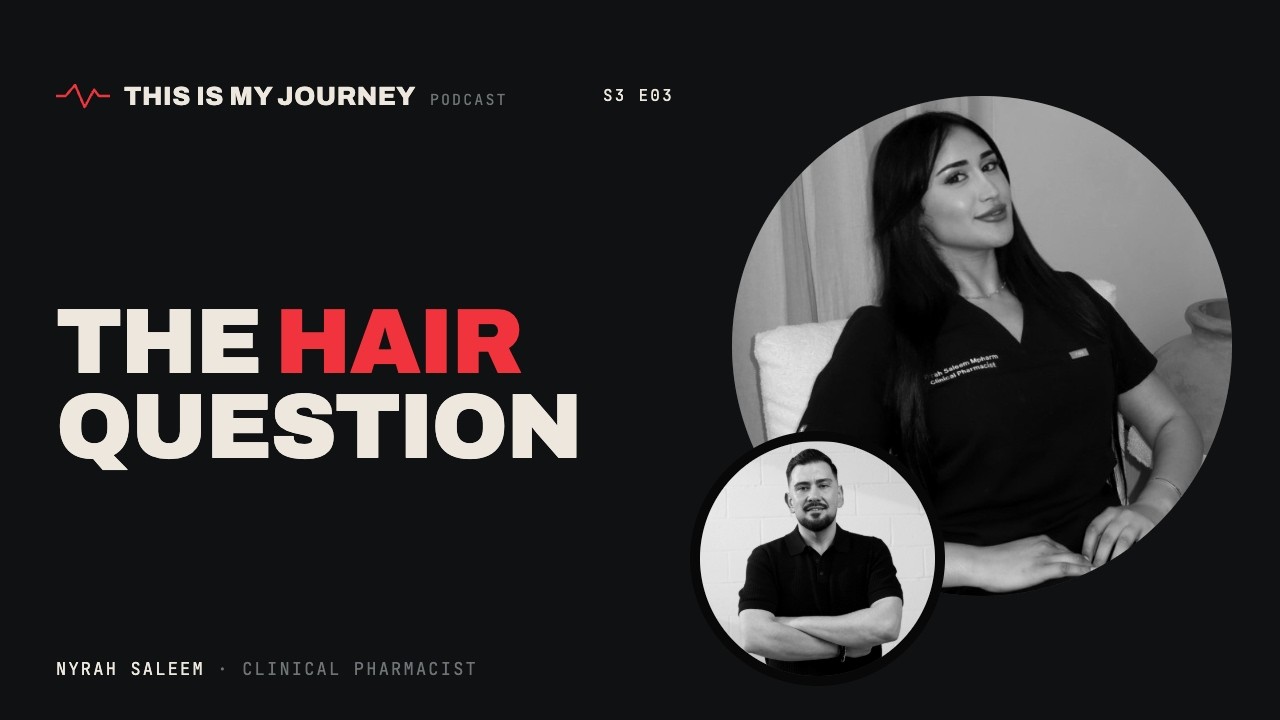
In this episode I'm joined by Nyrah Saleem, a clinical pharmacist and independent prescriber, and an award-winning health creator who shares evidence-based advice on skincare, hair health and nutrition with over half a million followers. She's the founder of Nyra Nutrition, a pharmacist-formulated supplement brand.
We talk about what's actually happening when your hair starts shedding and whether it's the drug or the weight loss, how long it really takes to come back, whether anything genuinely speeds that up, the nutrient deficiencies worth worrying about, and which supplements are worth your money and which are expensive gimmicks. She also covers how to read a supplement label properly, what interactions to watch for alongside these medications, and the things people are too embarrassed to ask a pharmacist.
SOURCES REFERENCED IN THIS EPISODE
Gupta AK et al., "GLP-1 therapies and hair loss: a systematic review of current evidence and implications for counseling", Science Progress, 17 April 2026
Vitamin D intake data: Frontiers in Nutrition, April 2025 (n=69)
ABOUT THE GUEST
Nyrah Saleem
Nyrah Saleem is a clinical pharmacist and independent prescriber, and a health creator who shares advice on skincare, hair health and nutrition with over half a million followers. She is the founder of Nyra Nutrition, a pharmacist-formulated supplement brand.
MORE EPISODES LIKE THIS
HRT, Mounjaro and the Heart in Midlife
S3 E4 · Dr Komal Patil-Sisodia · 46 min
The Weight Loss Drug After Mounjaro: Retatrutide
S3 E2 · Dr Fatima Cody Stanford · 52 min
Loose Skin and Ozempic Face After Weight Loss
S3 E5 · Dr Frank Agullo · 28 min
FULL TRANSCRIPT
Today on This Is My Journey, we're tackling the side effect that upsets people more than almost any other. Not the nausea, the hair, and it is real. A systematic review published in April 2026 this year in the journal Science Progress pulled together 24 studies and found hair loss occurred at 6 cases per 1,000 patient years on GLP-1 medication against 0.8 per 1,000 on placebo. 5.4% of people reported hair loss compared with 0.9% on placebo. And then there's the other half of the problem. When you're eating a fraction of what you're used to, where are the nutrients coming from?
One study last year found that 98.6% of people. On these medications, we're below the recommended intake of vitamin D alone. So which supplements actually matter and which are just expensive gimmicks? So my guest today is a clinical pharmacist and she's going to tell us straight. Super excited about this one. Let's roll the intro and get into it.
When I started, I was on my own. Two years ago, I began GLP-1 medications for chronic obesity with no real idea of what was coming. Not the good parts, not the hard parts, and definitely not the parts nobody warned you about. So I went looking for answers, and what I found was just noise. Opinions, judgment, people selling something, and everyone had a take, and nobody had the truth. 126lbs down, I'm still on this road, still learning,
still working out what maintenance actually means. Because losing the weight, it turns out, was only half the story for me. I'm Marc, and this is This Is My Journey. Every week I sit down with the people I couldn't reach back then. Leading doctors, obesity specialists, psychologists, dieticians, fitness experts, surgeons, and the people who actually understand what this medication does to your body and your mind, and who'll tell you straight. And alongside them,
working professionals and people walking the exact same road as you because their answers they matter just as much just honest conversations about what this really takes the science the setbacks and the stuff you won't hear anywhere else if you're on glp ones or you're thinking about starting them or you're just trying to make sense of it all this podcast is for you because nobody should have to do this alone not anymore Welcome back everyone and today I'm joined by a clinical pharmacist, an independent prescriber and an award-winning health creator whose entire mission is making evidence-based healthcare simple and accessible. Nyrah Saleem shares trusted advice on skincare, hair health, nutrition and wellness with over half a million followers and importantly for this conversation she's the founder of Nyra Nutrition, a pharmacist formulated supplement brand, as well as Nyra London. She's the person a lot of you would want standing behind the counter when you finally pluck up the courage to ask that awkward question. Nyrah, thank you so much for joining me today on the podcast.
Hi, thank you so much for having me. You know, it's such an important topic to discuss. And, you know, I've experienced hair loss myself, you know, I know how worrying it can be to see hair on your bed, hair in your shower. So I think after today's session, I think I'd love to describe, you know, why it happens, what to do, and obviously what vitamins to take. And, and obviously, thank you so much for introducing me about My own social media journey, obviously social media can open so many different doors.
There's so many myths online, you know, you see on TikTok, you see on Instagram. My mission really is to make products evidence-based rather than just putting a whole load of trend-led focus vitamins and supplements out there on social media. So I'm super, super excited to have you and get into this conversation because I think it's such an important one, especially for anyone that's on GLP-1 medication. And, you know, these are all real issues that we come across. I myself have used GLP-1 medication. And I think it's a great thing.
Hair is a major thing and I think it all boils down really to, you know, everybody wants, wants to have lost the weight to feel as confident as they can. And to do that, it's making sure that you are healthy. You know, you are taking your supplements if you're not getting enough nutrition and obviously looking after your hair. I'm such a hair enthusiast and skincare enthusiast. So I just try to take as much care as possible. So yeah.
Yeah, this is a conversation I know a lot of people will want to take so much information away from and implement into their own journey. So, yeah, super excited to get into today's questions. So I suppose really to start off with. Let's start with the big one. I don't know you've mentioned it there already, but when someone's hair starts shedding a few months into rapid weight loss, so whether that is with the GLP-1 medication or bariatric surgery or whatever, what is actually happening there? Is it the drug or is it the weight loss itself based on the research?
Yeah, no, great question and so important to talk about right now. So this can simply be explained by a process known as telogen effluvium. So if I was to just break that down into simple science, our hair grows into three different stages. There's a growth phase, shedding stage and a rest stage. Telogen effluvium is like temporary hair shedding. It usually occurs when the body is under stress.
So for example, you've lost too much weight really quickly. Rapid weight loss, I mean losing between 0.5 to 1kg a week. your body sees that stress and it can literally push your hair from the growth phase into a resting phase. But the key thing is your hair might not shed straight away after the weight loss. It usually can occur after two or three months. So it might have a slight pause and then start to shed.
That's why when some people lose weight or they're on medications like Manjaro, they don't see their hair fall straight away. But Maybe after three or four months, they start panicking as they're seeing a lot more hair fall on their bed or in their shower. What I usually say is you need to look at the big picture. Now, you know, the evidence and the clinical trials, they've been published, but nothing has stated that the medication has any mechanism of action or any direct effect on the hair follicles themselves. So...
I usually say that we have to look at hair loss as one big whole holistic view. It can be a combination of factors. It could be due to the rapid weight loss, not having enough protein, not hitting your calorie intake, and of course, an underlying vitamin or hormonal imbalance. And that's probably the main reason why a lot of people experience hair shedding whilst being on these medications. And then they're automatically thinking there's a link here. This medication is going to cause me some serious hair damage.
I know for me, like just what you said there, it's like that panic when you're in the shower and you're like, why is there so much hair in the shower now? It's great to know the reasons why. I think this is why I resonated there with what you said. For me personally, any hair loss that I had, I felt like it was a multitude maybe of factors, that it was the fact that I just wasn't maybe eating the same as what I was and I wasn't getting the same nutrition. And I think what I have... find now is that the fact that I have supplemented that nutrition, I'm really trying to incorporate a lot of things, which obviously we can get into, but I think it's definitely really helped me.
The reassuring version people are told is that it's only temporary. In terms of your opinion, do you think is that true? How long are we really talking about before that hair starts to sprout back? Well, hair growth is a patient's game. You know, ask any female or male that's suffering right now with hair loss. Telogen effluvium, it is temporary.
So obviously, if you don't have an underlying hormonal issue, which is androgenic alopecia, hormonal-related hair loss, it can be reversed. So usually some patients, especially some of my own patients, have actually reported they've stopped the fat loss medication and their hair loss has stopped shedding. It is true. It is temporary. You can reverse it.
And, you know, there's so many things you can do to support normal hair growth. We'll definitely talk about that a little bit later on. The hair serums, the hair growth hacks. But I would say... you need to wait at least six to 12 months for any hair serum to work and for that telogen effluvium phase to kind of slowly reverse that's really i think really interesting because i think for a lot of people me included you maybe buy products and obviously like i said we'll get into them but like you buy them and you expect them just to work like instantly you've used them maybe one or two days and you're like we're back yet or are we here so yeah that's that's super interesting just in terms of that timeline and reassuring as well that obviously it's not hopefully a permanent thing for a lot of people.
Is there anything really that genuinely speeds recovery up in terms of those like hair follicles or like can protect your hair while it's happening or is patience the only real answer? Yeah, good question. So I always say there's no miracle hair loss cure or vitamin or serum out there that's going to guarantee you those hair growth results. What I always say is to first identify the causes, obviously go for your blood test, check your own stress levels because stress can also cause hair fall. and then treat it. I can share my little hair growth cheat sheet with you guys and I can explain what I'm actually personally using to grow my own hair.
So number one is obviously diet. They say to actually watch how much protein you're having when you're on these weight loss medications. Obviously, smaller, high-protein-dense meals are so important. I know dieting can be so boring, especially when it comes to the foods that you're shopping for. But, you know, make it fun. Go for those healthy fats.
avocados, olive oil, make your breakfast more exciting. So when you're dieting, you're looking forward to having your high protein snack. Remember, if you have no protein, your hair is just not going to grow. And in terms of serums and the beauty world, I think there's a new hair serum launched every single week. But there's only one ingredient that actually is proven to grow your hair. And it's got the most clinical evidence, and that's minoxidil.
You're going to You've probably heard of Minoxidil or Regain. It's great. It works. I've tried it. It's grown my hair.
But the only downfall is it can cause initial shedding in the beginning. So it's not ideal for everyone. It can actually scare a lot of users of Manjaro who's already shedding. So my top two alternatives to Minoxidil will be serums containing peptides and serums containing Aminexel and ginger root extract. Those two I've tried myself. I've tried serums for at least six months and I'm already seeing baby hairs.
So if you don't want to take minoxidil, those two serums are a really great choice to look out for. I've been using the Ordinary Peptide Serum. It's cheap, it's cheerful, it works. You don't need to spend £50 to £100 on fancy packaging. Just look for formulas with the right ingredients. So L'Oreal Aviv Coral.
Growth booster, that's about £17 compared to the Kerastase one, which is £50. A really big price difference, but the exact same formula. I call them sisters. Another really important hack I'd say is a lot of people spend all this money on serums. They buy the serums. but they don't use them correctly.
If you're not applying your serum, massaging it into the scalp and using a derma roller, which is a tool with small little micro needles which create those little punctures into the scalp to allow the serum to absorb, you're basically wasting your money. So you can spend so much time using all these serums, but if you're not using it consistently and you're not massaging it into the scalp properly, it's a waste of money. You probably see on TikTok, everyone's buying these red light LED masks and helmets. Now, that's actually proven to help with hair growth. But you need to buy hair masks that are high graded, high medical graded red light. rather than just a cheap one you find on Amazon.
So high protein diet, scalp massages, serum with the right ingredients. That's your first three steps to hair growth. And thirdly, most importantly, which is really close to my heart, is checking for vitamin deficiencies, especially vitamin D. I just find everything you just said there so, so interesting. I was like ticking in my head, you know, all the different things like, okay, right. Maybe I need to look at that now because I didn't know that before.
So yeah, I know that's really, really helpful. And do you know what is really helpful? To get those recommendations, you know, in terms of, okay, what has worked for you and what hasn't worked for you? Because yeah, I think looking at your hair, you have really long, luscious... healthy looking hair. So I think everybody should, should take that advice.
I've been there and yeah. Well, I will put a little cheat sheet. It works. It's simple and it works. Yeah, no, well, that's, I think a lot of people try anything, I think, when they're, when they're losing hair. So I think,
you know, for somebody like you, you're looking into the research as well and what's actually included in all these different serums and things. I think it's really, really helpful. So, you know, I suppose you did touch on it there about vitamins. So let's really move into that because the research on nutrient gaps in this group is fairly alarming, I would want to say. So, you know, what are the deficiencies that you'd actually be worried about in someone eating a third of what they used to? Now, I used to be a GP pharmacist.
I used to see people's blood test results daily. And major players for hair loss and the most common vitamin deficiencies I see, including minimal ones, are iron. I think most of the UK population have low iron, especially females with heavy periods. You can take iron daily through just your diet, like spinach and lentils. You know, go to Tesco's, shop the right foods, add more spinach to your trolley. Even if you have spinach in a morning smoothie, that's already boosting your iron intake, especially if you're vegan and you don't like having meat.
Secondly is obviously vitamin D. If you live in the UK where you're barely getting enough sunlight, Chances are you're vitamin D deficient. Definitely take at least 10 micrograms of vitamin D daily. A lot of people, they face vitamin D deficiency and then they're taking a prescription dose of like 20,000 units weekly. Seems like a high dose, but it works. Once your vitamin D levels are normal, you can then go on a lower dose of like 2,000 units weekly.
What I'd also say is to go for a blood test to check your thyroid gland. Now, a lot of people don't know this, but you have a thyroid gland in your neck and this is one of the most important glands in your body. It literally affects your metabolism, your hair, your skin and your nails. If your thyroid gland is underactive and it's not working in the most optimal range, it's going to damage your hair and affect your hair, skin and nails altogether. So iron, your vitamin D and your thyroid levels, three of the most important things to check during your next GP appointment. A lot of my patients, they check all three things.
Their blood tests come back normal, but they're still struggling with hair loss. What I say is to check the actual number on your blood test result. It could be that it's not in the optimal range. For example, your iron is normal, but it's not optimal. Okay. Try to aim for high levels of iron, you know, in the 30 plus range.
That could really have a big impact on your hair growth. There are them checks that obviously are really, really important. And that is one of them. So thank you so much again for bringing them up. So I suppose when there is a whole industry right now selling supplements to this exact group of people, we see them all the time as a pharmacist and a formulator because you have your own. What's genuinely worth the money and what isn't in terms of vitamins, minerals, you know, all that stuff?
Yeah, no, great question. Because obviously the marketing industry is a marketing gimmick. There's so many myths online, so many products being sold to us every hour. I always say, you know, keep it simple. Stick to your basics, your essentials, your iron, your vitamin D, your vitamin B12. And you can add then your additional minerals such as your zinc,
magnesium and ashwagandha. Now zinc is great for immunity and also your skin. Magnesium is the talk of the town right now. It's so important. It literally controls so many different processes in your body. Great for women going through the menopause and ashwagandha.
Everyone's talking about this cortisol belly or having too much stress nowadays. Ashwagandha is actually proven to lower your cortisol levels. But my key message when it comes to ashwagandha is always shop the And try to cycle the dose. You can take it for eight weeks and then have a break of four weeks. Also, look at the forms.
You know, when it comes to shopping for vitamins, there's so many cheap forms out there. So many poorly made formulas. I can make a long list of formulas to avoid. But, you know, when it comes to vitamin D, always shop vitamin D free with K2. This combination is so important. You need K2 to direct calcium to your bones rather than your arteries.
When it comes to magnesium, avoid magnesium oxide. It's barely absorbed and it's probably just going to lead to diarrhea and toilet visits. Okay. Yeah, that's really good advice. Just when you were saying that there about supplements, you go into some like shops and the difference in price, it's tempting to go for the cheaper option sometimes, but actually, and I think that's where I have kind of changed my thinking in the last year, whenever I am buying like supplements and things like that, like I am looking at what's in it and the quantities that's in it and how you, you know, it's made and where it's made and all these different things.
And I think it leads into what you're saying there. You know, there's so many cheap products out there and they're really poorly formulated. And just because it says something doesn't mean it's the same as something else. That's that's a little bit more expensive. That one that's maybe a little bit more expensive is actually a hundred times the product that is sitting beside it. That's half the price based on what I've just said there.
How do you tell a good supplement from a bad one? I suppose what should someone be looking at on the labels? Firstly, when it comes to supplements in general, I usually do think multivitamins are a bit of a waste of money. They're usually underdosed, loads of unnecessary fillers. And gummies, I'd say, always avoid because they're full of sugar and they have poor absorption. When it comes to hair growth, avoid biotin hair gummies.
Their marketing gimmick, biotin only works if you have a deficiency. So instead, strip it back to the basics like your iron and your vitamin D. I walked into Boots the other day and I saw a new vitamin section for GLP-1 users. And I was a little bit shocked. You know, I looked at the label. I looked at the product.
The industry is now marketing vitamins just for GLP-1 users. I think that's slightly gimmicky. You don't need a vitamin just for GLP-1 users. They all also need the same vitamins, vitamin D, iron. and your vitamin B12. So don't get fooled by what it says on the front of the label in terms of marketing and promises.
Any vitamin that says guaranteed hair growth, ignore. Because there's so many false claims now on these labels. It's getting quite, quite ridiculous now. What I also... want to talk about is obviously collagen collagen there's there's there's not enough evidence for collagen i've actually tried collagen it did work for me i took it for three months but it's the type of collagen you buy so always look for hydrolyzed collagen because those are the formulas that have higher absorption In terms of looking behind the label now, any label needs these things.
It needs to have the percentage nutrient reference value, which is obviously how much you should take in relation to the adult recommended dose. It needs to have the clear formula listed, the dose of each formula. Avoid any vitamins that just say blend at the back of it because this is so vague. You don't know what's in that blend and you don't know how well it's absorbed into the body. I also really focus on the form. So remember previously I mentioned magnesium.
Don't buy magnesium oxide. It's cheap and it's a waste of money. Instead, look for forms such as magnesium glycanate, magnesium malate and magnesium taurate, three of the best forms of magnesium, which is also present in my own formulas at Nyra Nutrition. Just to summarize, a good vitamin label. It has a clear purpose, transparent label, and it's a sensible dose. That's really, really, really helpful.
And a lot of that I didn't know. I suppose it is navigating all them marketing gimmicks, like you say. And we are in a world now where businesses can make certain claims about things. And I think that's where it's all down to like clinical evidence and all that stuff. So yeah, really, really, really helpful hints and tips there for people to look out for whenever they're next going in to buy their supplements, whether it's on TikTok or into a chemist or whatever alongside these medications is there anything that could potentially interact with these medications I suppose just one that's maybe in my head is like for example whether everybody can take electrolytes or not depending on where they are in their journey what would you say to that yeah no good question so GLP-1 mimetics
Generally, they're safe to take with many other medications. I'd definitely avoid it with any herbal treatment that's seen as a fat burner or a weight detox tea. Definitely avoid taking alongside those, especially if you want to just see clear results with your GLP-1 mimetic. electrolytes there's no clear evidence to say that's a dangerous interaction instead actually it's quite good to you staying hydrated as you're losing so much to my knowledge there's no there's no there's no risk in taking alongside mimetics i suppose for me i'm just always conscious of the salt intake sometimes within electrolytes and whether people can take them or not but i think for the most part what you're saying there i think people are are losing that much and to stay hydrated it was really really helpful for me to take them every day and they really helped also a lot of my side effects on the medication as well because obviously a lot of them the headaches and the nausea and stuff can almost occur from not being hydrated so it really helped to keep me hydrated so that's where I find them really really beneficial amazing you don't need to spend a lot of money on electrolytes either if you can't afford the expensive electrolyte sachets you can always just have salt and a little bit of water I think in terms of taking your GLP-1 mimetic, another thing that I think is really important to discuss is obviously how you're even injecting it.
You know, make sure you're using the same time each week. And also rotating the injection sites. Some people are actually using the same spot of the skin, which causes, you know, a fatty layer under the skin, which is just going to reduce the absorption of the medication over time. Obviously, make sure same time each week and rotating the injection sites. Yeah, that's definitely a good one. That's one I talk about all the time as well.
What about the questions people are too embarrassed to ask a pharmacist? So, you know, what do you wish more people would just come out and ask about as opposed to just keeping it to themselves? We're your local pharmacist. You know, we've seen it all from, you know, cuts, bruises, fungal infections, any embarrassing sexual health problems. We're here to help. You know, we offer that non-judgmental friendly zone in that environment.
What I say is that all symptoms are normal until they become growing. especially when you're on a GLP-1 mimetic, things to look out for is severe nausea, severe vomiting, or abnormal stomach pain that's just not right for you and your body. You know, everything is normal until it becomes abnormal. And the way pharmacists monitor that is by looking at the frequency of the symptoms, the intensity, and the duration. What I always say is, detect any issues early, diagnose fast and treat early.
If we can do all, if all healthcare professionals can do all three of those things, I think the world will be a much healthier, happier place. Yeah, I totally agree with you. So I suppose, you know, let's get into talking about Nyra Nutrition. So what did you find wrong with what was already on the market at the minute? You know, what made you really decide to, you know, go after creating your own formulation for people? No, lovely question.
Thank you for asking this. But I think what's missing from the supplement industry at the moment is safe patient education. No hypes, no trends, just stripping it back to safe patient education and going back to the basics. I think a lot of brands now are missing that evidence-led patient education rather than cheap mass-produced formulas made by pharma. I think I wanted Nyra Nutrition to be really purposeful, all formulas to be carefully handpicked with the right doses, the right forms. and clean and also vegan and halal.
This is so hard to find vegan and halal supplements that actually worked at a really good price point as well. A lot of customers now, they're more aware of what they're putting inside the body. So I think the more transparent you are as a brand, as a founder, the more you can kind of build trust with your customers and your patients. With all the vitamins I sell, I actually offer free consultation and an ebook. So I'm making sure my brand breaks the market into taking it back to patient and evidence-led products that actually work, that you need for getting all the marketing gimmicks and all the trends that you see on TikTok and Instagram.
No, I think that's really, that's really a nice addition to that because I think, you know, I think the general person is very unaware what they need, what they don't need, how to actually tell if something is working, I suppose. Once they start taking, you know, additional vitamins, like how do you tell that this is actually doing something for you and whatnot? So I think that's a really nice personal touch, I think, to have that consultation if, if, they want that like with you get to know what they're taking and i think it's it's really really fantastic what you're doing i think that's where i love where this you know people like you bringing out things like this because you understand it you know it's not just a corporate company selling to the masses i really think there's you know for people like you that are that's start a brand like this you know i'm very similar myself but i think you know there's so much heart goes behind it and and thought and expertise and all that kind of stuff so yeah I would encourage everybody to go check it out we'll drop a link in the caption to this podcast episode so everybody be able to go and check it out and and see what you have there but I suppose really just finally where can people find you you know obviously you're all over social follow you i think everything you put out is so educational and really plain english for people that they can understand it and i think that that's what makes your content resonate so much with so many people which is why obviously so many people do follow you but you know how do people get hold of Nyra Nutrition Nyra London tell everyone where to go and what you have coming up with you
Yeah, absolutely. So you can find me at Health with Nyrah on TikTok, YouTube, Facebook. I know a lot of the Facebook aunties are following me now, which is great. My DMs are always open. So drop me a message anytime you want a question about a vitamin or even your weight loss medication. I'm more than happy to help.
And Nyra Nutrition, you can find it at nyranutrition.co.uk. Definitely add it to the bottom of the podcast. And just one final thing for me is I know weight loss medication is a long journey. It's a scary journey. What I would suggest is to keep a little symptom diary or food log. Track your progress, monitor your symptoms.
And if there's anything you're worried about, you can speak to your pharmacy or your GP. I know GPs can be a little bit intimidating, but your pharmacy is always open. Some pharmacies are even open 24-7. And a lot are offering the weight loss service as well in both Ireland and in the UK. And we're more than happy to speak to you at any time. That's absolutely fantastic.
Nyrah, thank you so much for giving up your time today. I know you're a busy woman. And yeah, I think it's really, really helpful advice there that we've talked through for people. And a lot of things that they can take away and implement into their own business. daily lives you know taking this medication and even outside of that anybody that's just on either a weight loss journey or just a general just wanting to feel their best and look their best and yeah I think all of that is is so so valuable so thank you again and yeah I wish you the best success with Nyra Nutrition and everything else that you've got going on thank you so much. Thank you so much thank you for having me.