


SHOW NOTES
I spent months rubbing creams into my stomach, braced for the loose skin to show up there. It was my face and my neck that changed.
An estimated 1.6 million adults in Great Britain used a GLP-1 for weight loss in the year to early 2025, and almost none of them are told what happens to their skin. The published literature on removing excess skin after major weight loss is surgical literature. Creams are not in it. So the question is not whether skincare fixes loose skin, because it does not, but what it can do while your skin adapts, and what you do about the rest.
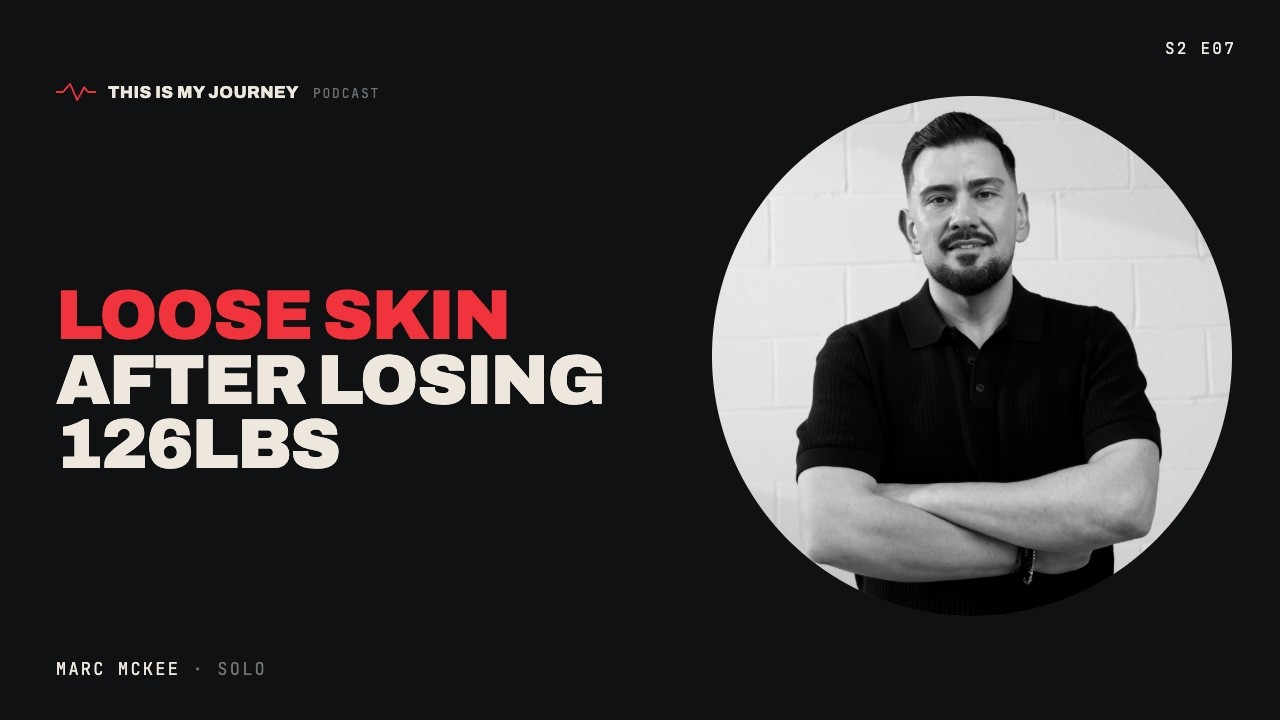
Today it is just me, no guest. I lost 126lbs on Mounjaro from August 2024, and five or six months in my skin started to change. I am doing it because skin is what people ask me about most, and because the comments under a Daily Mail piece insisted I must have had surgery. I had not. I should say plainly that I own a skincare brand, ElastiK Skin, which came out of this experience, and I talk about my own products here, so take that as the view of someone who sells them.
I talk about what I tried and what it did, barrier creams, peptides, hyaluronic acid, collagen drinks that are nowhere near the miracle they are sold as, filler, Botox and Profhilo, and red light therapy, which I felt the most from, though what I noticed was brightness and tone rather than tightening, which is my experience and not evidence, the five stage routine I ended up building and the thinking behind each step, and the limits, because skincare and devices support skin, they do not replace surgery. I reached maintenance in May 2025 and gave myself a full year of holding steady before considering a procedure, because skin can stretch again if the weight returns. I am planning neck surgery. If you have lost a lot and keep catching your face in the mirror, this one is for you.
SOURCES REFERENCED IN THIS EPISODE
University College London. "Prevalence of use and interest in using glucagon-like peptide-1 receptor agonists for weight loss: a population study in Great Britain." BMC Medicine, 8 January 2026. 1.6 million adults, 2.9 percent of those surveyed.
Giordano. "Removal of excess skin after massive weight loss: challenges and solutions." Open Access Surgery, 2015. Excess skin is addressed by excisional body contouring. No topical option appears.
No published research shows that topical skincare tightens significant skin laxity after major weight loss, and the figure quoted in the episode for how common loose skin is could not be traced to a primary source, so it is left out here rather than repeated.
ABOUT THE GUEST
Marc McKee is the host of This Is My Journey. He lost 126lbs on Mounjaro from August 2024 and reached maintenance in May 2025. He owns ElastiK Skin, a skincare brand that came out of this experience, and talks about his own products in this episode, so his view is that of someone who sells them.
MORE EPISODES LIKE THIS
8 Stone Down and Pre-Diabetes Reversed on Mounjaro
S2 E6 · James Taylor · 38 min
Skin Removal Surgery After Weight Loss: When Is It the Right Call?
S2 E8 · Dr Gediminas Samulėnas · 30 min
Is Obesity a Disease or a Choice? A Doctor Who Lived It
S2 E5 · Dr Sachin Khunti · 29 min
FULL TRANSCRIPT
Most weeks I sit down with guests who share their journeys and expertise, but today's episode is a little bit different because today it is just me. And the reason I wanted to do this episode is because there's a part of the transformation that people don't talk about nearly enough. And right now, weight loss medications like GLP-1 treatments are changing millions of lives around the world. And in the UK alone, estimates suggest that around 1%. and a half million adults have used these medications like Manjaro, Wigofi in the past year and millions more say they would consider them. So this isn't a small movement anymore. It is huge. And people talk about the weight loss. They talk about appetite changes. They talk about confidence, health improvements and transformation. But there's something else that comes with it that nobody talks about properly and that is skin. So let's roll the intro and we'll get into it. Welcome to This Is My Journey, the podcast where real people share real stories of transformation, resilience, and growth. I'm Marc and after navigating my own path through major lifestyle change, I created this space to open up honest conversations around identity, mindset, and what it really takes to evolve. So along the way, we'll also hear from professionals, you know, from pharmacists to psychologists and fitness experts who help us make sense of the science and support behind these journeys. So whether you're just starting out deep in the process or you're finding your footing after big change, you are not alone. This is your place. This is my journey. Let's walk it together. Welcome back to This Is My Journey and today's episode is about something that becomes the next chapter for a lot of people after weight loss. Skin, endless skin and skin that is changing and learning how to support your skin when your body is evolving. Because studies suggest that more than 70% of people experience some degree of stress. Loose or changing skin after significant weight loss. That's exactly what I experienced. So today I wanted to talk about it honestly. I want to talk about my own experience with skin during my weight loss journey and the things that I tried that worked, the things that didn't, the treatments I experimented with and just how that journey actually inspired something much bigger.
So yeah, for anyone who doesn't really know my story, you know, I started my weight loss journey back in August 2024. Seems like a long time ago now, but yeah, since then I've lost 126 pounds and that's about 57 kilograms or 126lbs. And every single pound of that weight loss came from using Manjaro and it has genuinely been life changing for me. Because when you've lived in a body that has been overweight for most of your life and suddenly you start seeing those changes that you never believed were possible, it's emotional and you feel proud and grateful and you just feel like you're finally taking control of your health again. So, you know, what many people, though, don't always tell you is that the journey just doesn't end when the weight comes off. In many ways, you know, that's when a new part of the journey begins. And that's when you're not going to be able to do that. For me, the changes in my skin didn't happen immediately. I would say it was probably around halfway through my journey, about five, six months in, that I started noticing it. And what is funny is that the area I had always worried about the most was my stomach. Like a lot of people, I thought loose skin around the stomach would be the biggest issue. So I was doing everything I could. I was using creams, oils, serums, anything I thought that might help with that area. But actually, the area that changed the most for me, it wasn't my stomach. It was my face and my neck. And I remember one day just looking in the mirror and thinking to myself, wow, like my face had changed really quickly. the fat pads in my face had reduced, you know, my skin looked looser. My neck had started to develop this, I can only describe it as like a turkey neck look. And for me, honestly, I didn't think my skin looked that great at that point. And, you know, when I look back at photos and stuff, I look tired. I look lax. It looked like I was really trying to catch up with everything that was happening. Yeah. And emotionally, that's quite a strange place to be because on one hand, you feel incredibly proud of what you've achieved. You know, your health's improving, your confidence is improving, your life is improving. But at the same time, you feel like you've almost moved from one problem to another.
And, you know, I want to be very clear that the after problem is not even close to being as serious as the problem before. But it is something that people notice. And for me personally, my neck has always been an insecurity. You know, partly genetics. You know, my family, every one of my family has a similar neck structure. But losing that weight definitely made it a lot more visible. You know, when you're someone who creates content online, you know, your face is public. People see it at every angle, photos, side profiles. video. And that can really affect your confidence. You know, another layer to this journey for me is that I've done a lot of it publicly as well, which is not everybody is in the same boat, you know, but for me, this is an experience that really stood out. And at one point I did a Daily Mail article. They actually wrote one on my transformation. And I'll be honest, the comments underneath that were brutal and they really affected me. And, you know, people were saying things like, you know, he must have had surgery. He doesn't have a belly button. You know, he's definitely had skin removal. And the truth was, I hadn't. But it made me realize something that people automatically assume surgery must be part of the weight loss. And for some people it is. That's completely okay. But if someone has worked incredibly hard to transform their health and wants surgery to feel comfortable in their own skin, that is their decision and nobody should ever be shamed for it. So, yeah, when I started noticing those changes in my skin, I went into research mode. It's literally, you know, I'm a nerd for it, but anyone who knows me will know that when I get interested in something, I research it, you know, I tried everything. I tried topical skincare, barrier repair creams, peptides, hyaluronic acid, vitamin C, collagen drinks. But yeah, spoiler alert here, collagen drinks are not the miracle people think they are. They can support things slightly and they do help, but they're only one small piece of the puzzle. You know, I also tried aesthetic treatments. I've had a little filler, Botox, Profilo Structura, nothing extreme. And it's really just been experimenting to see what worked. But...
One thing for me became very clear very quickly. And to me, there is no magic product. Skin responds to routine and consistency. And for me, the massive turning point was actually red light therapy. So I discovered it by accident. I visited a wellness studio and they had red light therapy there that you could get into for your full body. And at that time, it wasn't nearly as mainstream as it is now, but I had read a few scientific papers about it. So I was curious and I do remember thinking, How can light possibly change skin? But like everything else, I went away. I researched it, you know, different wavelengths, skin interaction, you know, where some clinics are using them. And once I started using it consistently myself, I noticed changes within about two weeks. My skin looked brighter. My complexion improved. My skin felt tighter. And that's when I realized something really important. Consistency beats intensity every single time. So 10 minutes a day, 12 minutes a day, you know, done consistently as part of a routine. That's where the real changes happen. And this is where something else blended because every day, you know, during live streams back at the start of my journey, people were asking me the same questions. So what are you using on your skin? How are you dealing with lift skin? What routine are you doing? And I realized something that people weren't just curious. They were worried about this. And one day someone did say something in a live stream that stuck with me and it was, why can't our skin just be like elastic and bounce back? And for me, that was the start starting point and turning point for Elastic with a K, it's normally spelt with a C, but I'm Marc with a C, so I flipped it and that's where Elastic with a K and where Elastic Skin started. So, you know, the brand isn't just about products, it is about a philosophy because one thing I realized during this journey is that skin doesn't just age. It evolves and it changes because of weight loss, because of hormones. You know, we've different lifestyle changes that happen, stress, age. All of these things are all happening at the exact same time. The skincare industry doesn't really talk about that properly. Most skincare brands promise these dramatic transformations or miracle results that are complete lies because...
For me, skin doesn't work like that. It adapts gradually. I know I've experienced it and it responds to that consistency and repetition. So that's the entire philosophy behind elastic skin, supporting skin through that evolution, not trying to aggressively, I suppose, fix it. And instead of me creating some random products, I created something called the Skin and Evolution System, a routine built around five stages. So hydration, structure and elasticity, renewal, barrier repair and light based skin support. And each stage supports a different function of the skin rather than trying to force some dramatic changes overnight. Because real skincare results come from systems, not from one miracle product. And within that system, there are a few products that I'm really excited about. And yeah, I did want to talk a little bit about them on here today as a almost exclusive to the podcast audience, because, you know, you're committing your time to me, but yeah, there is a peptide base serum called Regenesis Complex. It combines peptides, hyaluronic acid and antioxidants to support skin structure and elasticity over time. You know, there's another serum called Collagen Architect, which focuses heavily on hydration and moisture retention using ingredients like sodium PCA and hyaluronic acid. And, you know, hydration is incredibly important for skin elasticity. So when skin loses hydration, it looks thinner, less resilient. And, you know, there's also oil serum called Evolve, which uses hydration. buccanol plant-derived alternative to retinol and yeah i wanted something that supports skin renewal without causing real irritation because aggressive actives can actually really damage the barrier of your skin if they're overused and one of the most important products in the routine is something called the hydration continuum which is a multi-level hydration gel designed to support moisture balance in the skin because if the skin isn't hydrated nothing else works properly and And yeah, the final stage is a barrier repair overnight cream. It's a ceramide based night cream supporting the skin while it naturally repairs itself during sleep. So yeah. And then there's the other big side of it. So there's the device side, because one thing I realized during my journey is that technology and skincare should work together. So part of the system includes a flexible LED mask designed for daily use.
So it combines red light therapy, blue light therapy and infrared wavelengths to support skin appearance and consistency of routine. So the goal isn't aggressive treatments. The goal is routine adherence, you know, 10 minutes a day done consistently. And that is where the magic happens. And, you know, the brand aside and all that, I am so excited about. But I also want to be honest about something. Skincare can support skin. Treatments can support skin. But they cannot replace surgery for everyone. And for me personally, I am planning to have neck surgery in the future. quite close in the future. That's something I'll talk about in the next episode, but I made a rule for myself. You know, I reached maintenance in May last year, May 2025, and I promised myself that I would maintain my weight for one full year before considering any type of surgery because rushing into surgery straight after weight loss can create complications. If someone regains that weight afterwards, the skin can stretch again. So... you know, and thin skin, it's so bad for you. So it is important to be responsible with those decisions. So if you are listening to this and you are worried about loose skin, I want you to hear this. Don't assume surgery is your only option. You know, try skincare, try LED therapy, try aesthetics, try building muscle because building muscle can actually fill areas where skin feels loose. And, you know, the most important thing is patience because you might lose weight in months, but your skin might take years to fully adapt. So support it, be kind to yourself and stay consistent. And yeah, before we finish, I suppose I just want to say thank you to everyone who has been a part of this journey with me. You know, I don't always get a chance to say it, but, you know, Elastic Skin would not exist without this community. And, you know, if you do want to follow my journey with it and the brand, please. you know, join the mailing list at elasticskin.com. And remember, it's elastic with a K, not a C. You know, that's where I will be sharing updates, all the product launches and early access. And yeah, you can follow along on social media too. If there's Elastic Skin on Instagram, TikTok, Facebook, you know, just make sure the K is in there. Everything will be linked in the
Thank you for being part of the journey. Thank you for listening because, you know, this podcast is called This Is My Journey for a reason. And every single one of you listening is a part of that story.